


Hacker
Professional
- Messages
- 1,041
- Reaction score
- 851
- Points
- 113
Why do I need to know all this?
Any information on the Internet is considered a public statement, even if almost no one comes to your page.
Prohibited content is not just articles with step-by-step instructions on how to seize state power.
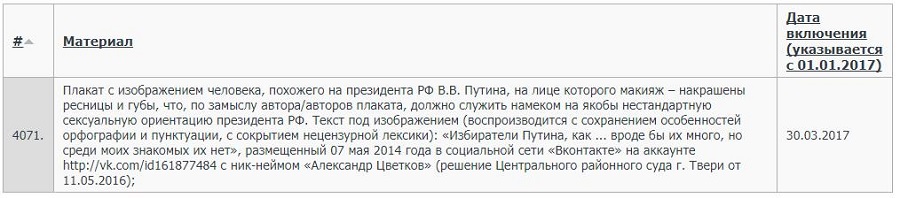
If an image is in the list, it means that its author was fined and their page was blocked.
Moreover, you don't have to be a content author – just click the "repost"button. Please note that there is such a thing as a "continuing offense" – even if you posted illegal content many years ago, but it is still available, you will be considered a delinquent.
And deleting content doesn't always help. If law enforcement officers managed to visit your page, then they will continue to be guided by screenshots.
For example, as in this case, the quote:
"During the inspection using the Yandex browser software from the Yandex home search page using a Canon laser printer model: LBP 6020, the content of Internet pages located at the above email addresses was printed on 4 sheets of A4 format."
So the only option is to know well what topics are prohibited in Russia and, if possible, do not touch them.
Inciting hatred and enmity (Article 282 of the Criminal Code)
Fine of 300,000 to 500,000 or up to 7 years in prison.
What you can't do. It is forbidden to humiliate people on the grounds of gender, race, nationality, language, origin, attitude to religion or belonging to any social group.
According to this article, in most cases, people are judged for making statements on the Internet (according to to to the Sova analytical center, in 85% of cases). Especially often these are comments, reposts, and images in social networks.
For example, in Moscow, an 18-year-old young man posted materials with Nazi propaganda on VKontakte. A criminal case was opened against him.
+ in the Perm Region for xenophobic articles on the Internet, a local resident was given 5,5 years of a real term.
A 17-year-old Kirov resident was fined for making videos on VKontakte inciting hatred on the basis of ethnicity.

Admittedly, most of the banned content is really disgusting. I hope you haven't posted anything like this on your page.
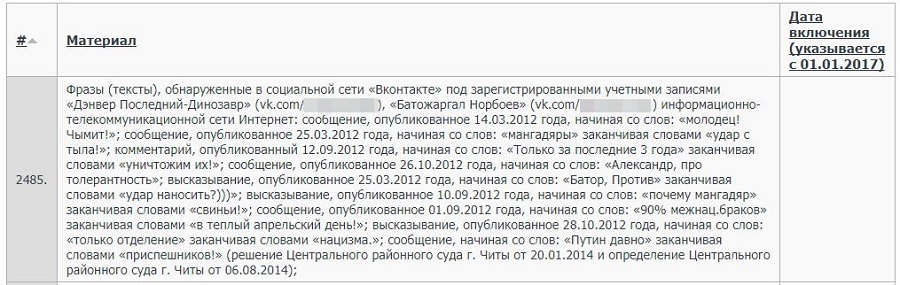
Unfortunately, the courts do not report exactly which statements they consider criminal. But the content of those convicted under this article is usually included in the Federal List of Extremist Materials.
Even with a cursory review, it is clear that it is full of memes and demotivators on the topic of interethnic and interreligious relations. Be more careful. You shouldn't even joke about it.
The expression "belonging to a social group" deserves special interest. What it is, the law does not explain. But based on the use cases, you can understand that any association containing more than one person can be attributed to a social group in general.
A 19-year-old resident of Saratov was sentenced to compulsory labor for inciting hatred against the social group "quilted jackets".
+ In Krasnoyarsk, a local activist was accused of inciting hatred against the social group "atomschiki" after his publications on his page "VKontakte".

Don't joke about interethnic relations
What you can do. If someone annoys or scares you, you can write about it. But use correct expressions and never call for discrimination, beating, or even killing anyone. Even as a joke.
Calls to extremism ([Article 280 of the Criminal Code) and separatism (Article 280.1 of the Criminal Code)
Compulsory labor or up to 5 years in prison.
What you can't do. You can not say that it is desirable (and even more so necessary):
- make a coup d'etat;
- commit a terrorist attack;
- infringe on other people based on gender, race, nationality, attitude to religion and belonging to a social group;
- make some part of Russia an independent state or attach it to another country;
- interfere with the work of government agencies;
- finance extremist and terrorist organizations.
These articles overlap with the previous one, but they bring fewer cases. Most often we are talking about calls for separatism. Remember that calling to reduce the territory of Russia is a criminal offense.
We are talking not only about Crimea (although in 2015 a court an engineer from Tver to 2 years in prison for reposting an article with the title "Crimea is Ukraine"), but also about national movements in Russian regions.
For example, in Krasnodar, an activist of the movement for the federalization of Kuban was jailed for two years.
+ In Buryatia, a blogger who called for the unification of the Mongolian peoples received a suspended sentence.
What you can do. Refrain from approving statements about extremism and terrorism, and especially do not encourage others to join it. And carefully read and watch what you repost. The author may start with abstract arguments and end with calls for extremism and separatism. And it will be your fault.
Justification of terrorism (Article 205.2 of the Criminal Code)
Fine of up to 1,000,000 rubles or up to 7 years in prison.
What you can't do. It is forbidden to call for terrorism and publicly justify it. We cannot say that terrorism is the right thing to do, that it needs to be supported and imitated.
I haven't been able to find any cases that have been tried for a meme or photojab. Most often, convicts actually expressed approval about terrorism or reposted those who spoke out. Don't do this if you don't want to be in their shoes.
What you can do. You can't justify terrorism as a method, but not the terrorists themselves. I.e. psychological excuses such as "he just got confused and got into bad company" or "he was young and inspired" are not considered to justify terrorism.
Rehabilitation of Nazism (Article 354.1 of the Criminal Code)
Fine of up to 300,000 rubles or up to 3 years imprisonment.
What you can't do. It is forbidden to deny and approve the Nazi crimes proved by the Nuremberg Tribunal. It is forbidden to justify the main Nazi criminals. It is forbidden to " spread deliberately false information about the activities of the USSR during the Second World War." It is forbidden to insult the memorable dates of the Great Patriotic War and desecrate the symbols of military glory.
Use caution in online discussions
Rehabilitation of Nazism is somehow prohibited in most European countries. But in Russia, only two years ago, it became a criminal offense. They are rarely judged under this article. To date, only one guilty verdict under this article: a man reposted an article justifying the activities of Stepan Bandera.
Now the court is considering the case of a political activist from Volgograd, who posted on the web a photojab with the image of the monument "Motherland", doused with green paint.
What you can do. The problem is that no one but experts knows what exactly the Nuremberg Tribunal condemned. Although a short version can be viewed in "Wikipedia", but even it's hard to remember.
Therefore, do not repost articles with an alternative version of the Great Patriotic War. Do not draw memes with monuments and symbols of the Second World War and do not share them with your friends.
Insulting the religious feelings of believers (part 1 of Article 148 of the Criminal Code)
A fine of up to 300,000 rubles or imprisonment for up to 1 year.
What you can't do. Unfortunately, the law does not explain what the feelings of believers are and what their offense is. It only says that the action should be public, it should express disrespect for society, and the goal should be exactly an insult.
This article is rarely used: in 8 months of 2017, only 4 guilty verdicts were issued, so it is still difficult to judge what is considered a crime and what is not.
The most famous story is the case of Ruslan Sokolovsky, who posted a video of catching Pokemon in the temple. He received two and a half years of probation. Another story is Sochi case resident who reposted cartoons of Christ on the horizontal bar, in the gym and on the dance floor. He was fined 50,000 rubles.
What you can do. Do not create or repost images, memes, GIFs, or videos that insult religious symbols or characters. Don't insult religion yourself and don't repost offensive articles.
At the same time, do not confuse warm with soft. No one forbids you to be an atheist and criticize religion. You can't just do it in an offensive way.
Distribution of extremist materials (Article 20.29 of the Administrative Code)
Fine for people - from 1,000 to 3,000 rubles and blocking.
For companies - from 100,000 to 1,000,000 rubles and blocking.
What you can't do. You can find a list of extremist materials here. The problem is that it is very large: as of 2021, it has more than 50 00 materials. Moreover, it includes not only books and articles, but also videos, songs, memes and demotivators. Some of them are openly misanthropic, and some are quite innocent. You can't post them on your own page or repost them.

The law does not explain how to use this description to understand what is being said if the author's page is blocked
What you can do. If you find some content suspicious, look for it in the list before publishing it. But this method does not provide a one-hundred-percent guarantee: the text of the list does not contain the forbidden files themselves, only their names, addresses, and verbal descriptions. Lawmakers do not explain how to recognize a picture based on a verbal description.
In addition to materials openly devoted to hatred, pay special attention to religious articles: there are a lot of them on the list, and most cases under this article are initiated precisely because of religious materials. Moreover, religion does not matter: the list includes Christian, Muslim, Buddhist, and pagan materials.
Demonstration of Nazi symbols and symbols of banned organizations (Article 20.3 of the Administrative Code)
Fine for people - from 1,000 to 2,000 rubles and blocking.
For companies - from 10,000 to 50,000 rubles or more.
What you can't do. The law does not specify what exactly counts as Nazi symbols. But most often it includes the swastika and the SS emblem in the form of two lightning bolts.
A separate topic is symbols similar to the Nazi swastika: Celtic cross, kolovrat, left-hand swastika, etc. They are also banned, because the law considers them confusingly similar to the swastika. Recently in Orenburg, a man was fined for tattooing a Celtic cross.
It's easier to use the symbols of banned organizations. They are all listed in a separate list (it is not very large) with a description of the symbolism. At the same time, not all their symbols are prohibited, but only those that organizations indicated in their constituent documents.
What you can do. Don't post a swastika even as a joke. Although Roskomnadzor said that it does not consider publication without propaganda purposes to be a violation, in fact this is not always taken into account.
Use caution when posting a Buddhist swastika. Most likely, law enforcement officers will not have any questions if you clearly indicate that we are talking about Buddhism. But the Buddhist swastika is dangerous without explanation: it is impossible to distinguish it from the Nazi one. Recently, for example, a local Buddhist artist was fined.For example, a girl from Buryatia was fined for a meme with the symbolism of grammar-Nazi, where a swastika appears.
Methods of manufacturing weapons and explosives(part 5 of Article 13.15 of the Administrative Code)
Fine for people – from 4,000 to 5,000 rubles and a block.
For companies - from 800,000 to 1,000,000 rubles and blocking.
What you can't do. You can not talk about the methods of manufacturing firearms and explosives. Even for peaceful purposes: for example, if you are engaged in chemistry and pyrotechnics. This prohibition is unambiguous and has no interpretation. Just don't post such information.
Drug propaganda (Article 6.13 of the Administrative Code)
Fine for people - from 4,000 to 5,000 rubles and blocking
For companies - from 800,000 to 1,000,000 rubles and blocking.
What you can't do. Prohibited to tell you how to develop, produce, or use drugs. You can't talk about the cultivation of narcotic plants and the benefits of narcotic substances.
What you can do. In 2015, it was proposed to introduce not a fine, but criminal punishment for drug propaganda. But the law did not pass the first reading in the Duma. At the same time, it was proposed to ban images of drugs, but lawmakers faced technical difficulties: how can you understand from a photo that white powder is a drug, and not powdered sugar? And that the characteristic plant is hemp, and not, say, water pachyra, which has very similar leaves? So images, especially stylized ones, are still allowed. But only if they are not accompanied by explanatory inscriptions, otherwise it is propaganda.
Promotion of homosexual relations among children (Article 6.21 of the Administrative Code)
Fine for people – from 50,000 to 100,000 rubles and a block.
For companies – 1,000,000 rubles and blocking.
What you can't do. It is forbidden to disseminate information "aimed at forming non-traditional sexual attitudes among minors". You can't say that homosexual and heterosexual relationships are socially equal. You can not impose information about homosexuality on children and arouse their interest in the topic.
What you can do. The law applies only to children, and therefore it is not difficult to circumvent it – just put the 18+ icon in a prominent place on the site, and write about anything on the topic. Lawmakers believe that this is quite enough.
Information about methods of suicide (part 1 of Article 13.15 of the Administrative Code)
Fine for people – from 2,000 to 2,500 rubles and a block.
For companies - from 40,000 to 50,000 rubles or more.
What you can't do. It is forbidden to tell children in detail about the ways and methods of suicide.
What you can do. The ban applies only to children. Therefore, you can bypass it in the same way as the previous one – put the 18+icon. Although in 2016, the RCN issued recommendations on careful coverage of suicides, but so far they concern only the media. Regular sites can write whatever they want.
What to do if this article scares you
I don't have exact statistics, but the vast majority of cases that I reviewed when collecting material for the article were initiated after posts and comments in VKontakte. And this is not just my opinion.
I do not know how much truth there is in the statements about cooperation between VKontakte and the investigative authorities. In general, I believe that the best way to protect yourself is not to speak out on the mentioned topics at all, or to do it as correctly as possible. But for insurance purposes, you might want to consider changing your social network.

