


Teacher
Professional
- Messages
- 2,669
- Reaction score
- 819
- Points
- 113
The process of evolution of cryptocurrency in the deep internet.
The information space is full of various videos and articles on the topic of cryptocurrencies. Anonymous digital money began to flourish in the mass consciousness around 2016. This is primarily due to the active use of bitcoin on underground trading platforms. Due to the openness of the technology and the great popularity of the words "crypt", "blockchain" and the like, a mass of one-day cryptocurrencies appeared, which artificially grew in price, attracting investors both from among business leaders and ordinary onlookers... The classic scheme looks like this: create a bunch of candy wrappers, then fill them with a price on any exchange, and at the peak of the price sell all your crypto-dummies, taking the real money of gullible people in exchange for unnecessary digital assets.
By 2018, in the minds of people, cryptocurrency had turned from a panacea for anonymous settlements into a speculation tool. By that time, hundreds of one-day cryptocurrencies had died, and the bitcoin rate showed big jumps, which can allow not only earning, but also wildly going bankrupt.
This article focuses on cryptocurrency, which was born at the height of the technology's popularity. Unlike other no-names, it was developed by a team with a name, and the currency itself was not advertised in Instagram profiles with a million audience. Below you will learn about the world's first crypto-coin, which has become fully adapted to work via I2P without a single need to access the regular Internet, where requests are subject to interception, analysis and blocking.
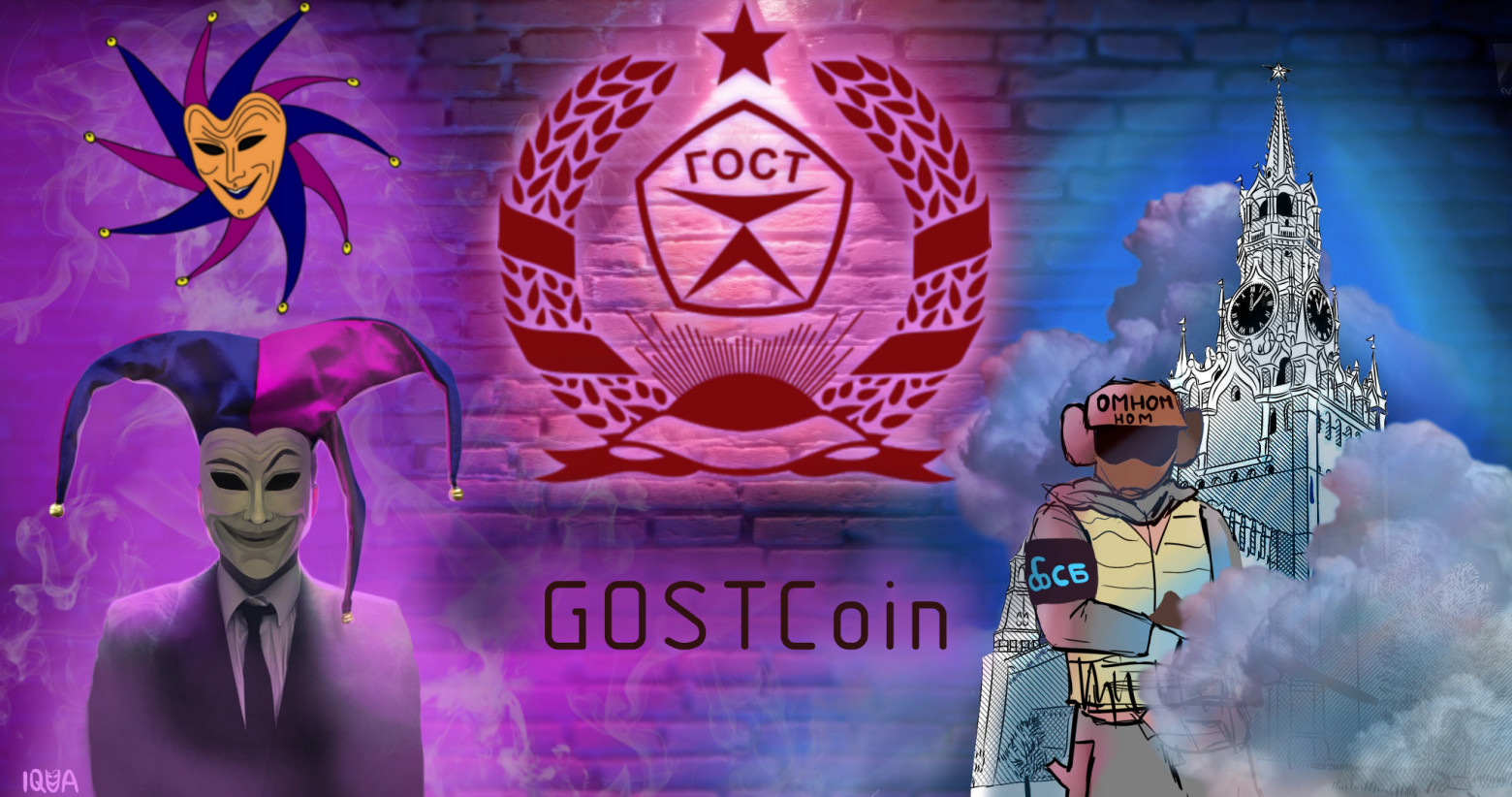
AnonCoin and GOSTCoin
Development of the first cryptocurrency that would work through the anonymous I2P network began in 2013 by a Norwegian programmer known as Meeh. It was AnonCoin. At the time, cryptocurrencies were not widespread, but savvy people saw a particular prospect for a coin operating over a hidden network. In 2015, orignal, the founder of the i2pd project, joined AnonCoin, and then several more anonymous users with nicknames recognizable in narrow circles. In short, PurpleI2P, a group of developers of an I2P router in C ++, joined the project little by little.
AnonCoin had a great future, if not for one "but" ... The main developer suffered (and possibly enjoyed) drug addiction. As a consequence, the lack of critical thinking made it difficult for him to listen to advice. Ultimately, Meeh disappeared altogether. As the old-timers say, he was hanging around. It was not possible to lead a project, with many details of which the main part of the developers did not agree. The Russian-speaking part of the small community decided to fork and develop it separately. The new project was named GOSTCoin. By the way, at the time of the split in the community, AnonCoin could not adequately work through the I2P network.
GOSTCoin is a cryptocurrency that uses cryptography according to the Russian state standard and was originally aimed at working through the I2P network. The project was founded in 2017. The beginning of GOSTCoin actually marked the complete extinction of the previous project.
The very first thing that catches your eye is GOST. The name GOSTCoin is based on the use of GOST R 34.10-2012 and GOST R 34.11-2012: 34.10 - digital signature function, 34.11 - hashing function. The 34.10 digital signature standard is similar to the foreign ECDSA algorithm - a signature on an elliptic curve, and the 34.11 hash function (Stribog) is similar to foreign SHA256 and SHA512.
A note of humor seems to be guessed in the use of GOST, but in fact, the choice in favor of the Russian standard was not at all accidental - all forks of bitcoin used the same secp256k1 curve in their signature, which theoretically made them equally vulnerable. At the peak of the popularity of cryptocurrencies, there were many specialists who were not opposed to experimenting with various attacks. Assuming the existence of a complete vocabulary of digital signatures on the secp256k1 elliptic curve, it would damage almost all cryptocurrencies at once. The use of GOST R 34.10 signature is a solution that brought GOSTCoin out of the common comb of identical signatures. Currently, it is not the only coin that uses a signature that is non-standard for other cryptocurrencies, but there are still few such coins, but special software for the selection of bitcoin-like addresses, there are only more and more.
The Russian cryptographic standards explicitly mention the Federal Security Service. This gives rise to some concerns, but on the other hand, it suggests that GOSTCoin uses the same cryptographic security standards as the government departments of Russia. In truth, common foreign cryptographic standards are also directly or indirectly affiliated with European and American law enforcement agencies. It just so happened in the world that avant-garde technologies are primarily mastered by the security forces.
On the Internet, you can find information about the audit of these Russian standards and conclude that there are theoretical weaknesses in everything, but their practical exploitation in order to attack GOSTCoin is from the realm of fantasy. No calls to the FSB office are made during the work of GOSTCoin.
Who and for what?
After the separation from AnonCoin, a lot of work was done, making GOSTCoin a workable tool for anonymous financial transactions. It is noteworthy that there was no investment in the development of a stablecoin working through I2P, except for the enthusiasm of the developers themselves. This is not uncommon for free open source projects, but in the case of GOSTCoin, an additional factor speaks of the purity of thoughts: developers could make money on their brainchild, because this is not just a cryptocurrency, but an anon's dream, but up to this point you probably have never heard about GOSTCoin. It is clear simply because no one advertised it widely. Both after the first release and four years later, GOSTCoin is exchanged on only two or three exchanges, one of which is in I2P.
Initially, the rate rose above twenty rubles for one "gost". At the time of publication of this article, the rate hovers around two rubles. The fact that the currency has existed for several years at a low rate, and all the same people are engaged in it, confirms the judgment that the purpose of creating a currency was anything but quick profit. Most likely, it is appropriate to talk about ideology, about the pursuit of privacy and anonymity, about something that lies at the basis of the old school's creed. I note that this material was created by me free of charge and at the time of publication I am the holder of one hundred coins mined for fun on a gig video card. This is less than three hundred Russian rubles, so my interest is also from the plane of enthusiasm and research passion.
The enthusiasm of the developers of the new cryptocurrency in 2017 was not exclusively "in itself", in the language of Kant. The weekend hobby had clear horizons. According to one of the active community figures, there were discussions between the developers that their coin, thanks to the use of standardized Russian cryptography, could attract the attention of some major Russian financial player like Sberbank or VTB. To attract attention, a topic was created on Reddit (due to lack of moderation, the channel was banned) and a couple of Russian-language news were published... At that time, cryptocurrency in Russia was not legally a means of payment, although the technology itself was already well-known. Perhaps the group of anons harbored hopes that the world was on the brink of cryptanarchism ... But alas. Based on the current state of affairs with digital money, I can assume that the anonymous coin actually did not have a single chance to take a place in a world where transparency of financial transactions and total control are paramount.
The established niche of GOSTCoin is quite modest: the only place where it is practically used is the anonymous trading floor in I2P. There is also one of the few exchange exchanges where players buy and sell "gost" for bitcoin and other cryptocurrencies (I will not leave the link for ethical reasons, since surfactants are still traded on the exchange). The hashrate of coin mining is very modest. At the time of the article's release, it can be compared to mining on sixty medium video cards. Despite this, the network still maintains a mining pool.
GOSTCoin in 2021
Perhaps, after hearing what you have heard, you will want to look at the coin live. This is easy to do. To get started, visit the official website, where you will find all the useful links. Ready binaries of wallets for Windows and Android are located in the official git-repository of the project, but users of other operating systems will need to build the wallet themselves from the source. Instructions for this case are attached. It should be noted that in order to work via I2P, you must have an I2P router with the SAM interface enabled, as described on the main page of the official repository. In i2pd, SAM is enabled through the configuration file by the parameter enabled = true in the section [sam]... The mining software is also open source and easy to find.
To make a backup of the created wallet, save the file wallet.dat from the application working directory. On unix-like operating systems, this is usually ~/.gostcoin/, and on Windows - %AppData%\Gostcoin\.
The article is based on the text from the video. The material does not call for abandoning everything and buying the mentioned cryptocurrency. You carry out any financial transactions with GOSTCoin at your own peril and risk.
The information space is full of various videos and articles on the topic of cryptocurrencies. Anonymous digital money began to flourish in the mass consciousness around 2016. This is primarily due to the active use of bitcoin on underground trading platforms. Due to the openness of the technology and the great popularity of the words "crypt", "blockchain" and the like, a mass of one-day cryptocurrencies appeared, which artificially grew in price, attracting investors both from among business leaders and ordinary onlookers... The classic scheme looks like this: create a bunch of candy wrappers, then fill them with a price on any exchange, and at the peak of the price sell all your crypto-dummies, taking the real money of gullible people in exchange for unnecessary digital assets.
By 2018, in the minds of people, cryptocurrency had turned from a panacea for anonymous settlements into a speculation tool. By that time, hundreds of one-day cryptocurrencies had died, and the bitcoin rate showed big jumps, which can allow not only earning, but also wildly going bankrupt.
This article focuses on cryptocurrency, which was born at the height of the technology's popularity. Unlike other no-names, it was developed by a team with a name, and the currency itself was not advertised in Instagram profiles with a million audience. Below you will learn about the world's first crypto-coin, which has become fully adapted to work via I2P without a single need to access the regular Internet, where requests are subject to interception, analysis and blocking.
AnonCoin and GOSTCoin
Development of the first cryptocurrency that would work through the anonymous I2P network began in 2013 by a Norwegian programmer known as Meeh. It was AnonCoin. At the time, cryptocurrencies were not widespread, but savvy people saw a particular prospect for a coin operating over a hidden network. In 2015, orignal, the founder of the i2pd project, joined AnonCoin, and then several more anonymous users with nicknames recognizable in narrow circles. In short, PurpleI2P, a group of developers of an I2P router in C ++, joined the project little by little.
AnonCoin had a great future, if not for one "but" ... The main developer suffered (and possibly enjoyed) drug addiction. As a consequence, the lack of critical thinking made it difficult for him to listen to advice. Ultimately, Meeh disappeared altogether. As the old-timers say, he was hanging around. It was not possible to lead a project, with many details of which the main part of the developers did not agree. The Russian-speaking part of the small community decided to fork and develop it separately. The new project was named GOSTCoin. By the way, at the time of the split in the community, AnonCoin could not adequately work through the I2P network.
GOSTCoin is a cryptocurrency that uses cryptography according to the Russian state standard and was originally aimed at working through the I2P network. The project was founded in 2017. The beginning of GOSTCoin actually marked the complete extinction of the previous project.
The very first thing that catches your eye is GOST. The name GOSTCoin is based on the use of GOST R 34.10-2012 and GOST R 34.11-2012: 34.10 - digital signature function, 34.11 - hashing function. The 34.10 digital signature standard is similar to the foreign ECDSA algorithm - a signature on an elliptic curve, and the 34.11 hash function (Stribog) is similar to foreign SHA256 and SHA512.
A note of humor seems to be guessed in the use of GOST, but in fact, the choice in favor of the Russian standard was not at all accidental - all forks of bitcoin used the same secp256k1 curve in their signature, which theoretically made them equally vulnerable. At the peak of the popularity of cryptocurrencies, there were many specialists who were not opposed to experimenting with various attacks. Assuming the existence of a complete vocabulary of digital signatures on the secp256k1 elliptic curve, it would damage almost all cryptocurrencies at once. The use of GOST R 34.10 signature is a solution that brought GOSTCoin out of the common comb of identical signatures. Currently, it is not the only coin that uses a signature that is non-standard for other cryptocurrencies, but there are still few such coins, but special software for the selection of bitcoin-like addresses, there are only more and more.
The Russian cryptographic standards explicitly mention the Federal Security Service. This gives rise to some concerns, but on the other hand, it suggests that GOSTCoin uses the same cryptographic security standards as the government departments of Russia. In truth, common foreign cryptographic standards are also directly or indirectly affiliated with European and American law enforcement agencies. It just so happened in the world that avant-garde technologies are primarily mastered by the security forces.
On the Internet, you can find information about the audit of these Russian standards and conclude that there are theoretical weaknesses in everything, but their practical exploitation in order to attack GOSTCoin is from the realm of fantasy. No calls to the FSB office are made during the work of GOSTCoin.
Who and for what?
After the separation from AnonCoin, a lot of work was done, making GOSTCoin a workable tool for anonymous financial transactions. It is noteworthy that there was no investment in the development of a stablecoin working through I2P, except for the enthusiasm of the developers themselves. This is not uncommon for free open source projects, but in the case of GOSTCoin, an additional factor speaks of the purity of thoughts: developers could make money on their brainchild, because this is not just a cryptocurrency, but an anon's dream, but up to this point you probably have never heard about GOSTCoin. It is clear simply because no one advertised it widely. Both after the first release and four years later, GOSTCoin is exchanged on only two or three exchanges, one of which is in I2P.
Initially, the rate rose above twenty rubles for one "gost". At the time of publication of this article, the rate hovers around two rubles. The fact that the currency has existed for several years at a low rate, and all the same people are engaged in it, confirms the judgment that the purpose of creating a currency was anything but quick profit. Most likely, it is appropriate to talk about ideology, about the pursuit of privacy and anonymity, about something that lies at the basis of the old school's creed. I note that this material was created by me free of charge and at the time of publication I am the holder of one hundred coins mined for fun on a gig video card. This is less than three hundred Russian rubles, so my interest is also from the plane of enthusiasm and research passion.
The enthusiasm of the developers of the new cryptocurrency in 2017 was not exclusively "in itself", in the language of Kant. The weekend hobby had clear horizons. According to one of the active community figures, there were discussions between the developers that their coin, thanks to the use of standardized Russian cryptography, could attract the attention of some major Russian financial player like Sberbank or VTB. To attract attention, a topic was created on Reddit (due to lack of moderation, the channel was banned) and a couple of Russian-language news were published... At that time, cryptocurrency in Russia was not legally a means of payment, although the technology itself was already well-known. Perhaps the group of anons harbored hopes that the world was on the brink of cryptanarchism ... But alas. Based on the current state of affairs with digital money, I can assume that the anonymous coin actually did not have a single chance to take a place in a world where transparency of financial transactions and total control are paramount.
The established niche of GOSTCoin is quite modest: the only place where it is practically used is the anonymous trading floor in I2P. There is also one of the few exchange exchanges where players buy and sell "gost" for bitcoin and other cryptocurrencies (I will not leave the link for ethical reasons, since surfactants are still traded on the exchange). The hashrate of coin mining is very modest. At the time of the article's release, it can be compared to mining on sixty medium video cards. Despite this, the network still maintains a mining pool.
GOSTCoin in 2021
Perhaps, after hearing what you have heard, you will want to look at the coin live. This is easy to do. To get started, visit the official website, where you will find all the useful links. Ready binaries of wallets for Windows and Android are located in the official git-repository of the project, but users of other operating systems will need to build the wallet themselves from the source. Instructions for this case are attached. It should be noted that in order to work via I2P, you must have an I2P router with the SAM interface enabled, as described on the main page of the official repository. In i2pd, SAM is enabled through the configuration file by the parameter enabled = true in the section [sam]... The mining software is also open source and easy to find.
To make a backup of the created wallet, save the file wallet.dat from the application working directory. On unix-like operating systems, this is usually ~/.gostcoin/, and on Windows - %AppData%\Gostcoin\.
The article is based on the text from the video. The material does not call for abandoning everything and buying the mentioned cryptocurrency. You carry out any financial transactions with GOSTCoin at your own peril and risk.
