

Carding 4 Carders
Professional
- Messages
- 2,724
- Reaction score
- 1,598
- Points
- 113
The art of cheating through the screen has become the most lucrative form of fraud.
According to the latest data from the US Federal Trade Commission (FTC), Americans have lost at least $2.7 billion due to social media fraud since 2021. It is argued that real losses can be significantly higher due to insufficient reporting on this issue. It is noted that the specified amount significantly exceeds the losses from any other methods of scams.
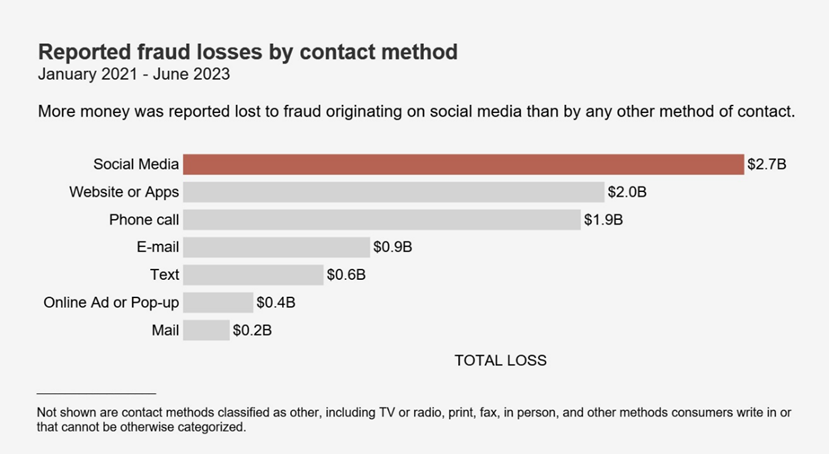
Losses from fraud depending on the method of communication with the criminal
A recent survey found that just 4.8% of fraud victims filed complaints with either the Better Business Bureau or government agencies. Most cases of fraud are not reported, and this indicator reflects only a small part of the actual damage. Social media scammers often advertise fake products in an attempt to trick potential victims into making a payment. The criminals then disappear with the money without fulfilling their promises.
In addition, scammers can attract victims with false investment offers, often associated with cryptocurrency. Another method is romance scam – sending unexpected requests to friends, where scammers pretend to be potential romantic partners in order to later ask for money from their victims.
The FTC recommends that users:
The FTC report showed that online shopping fraud was the most frequently reported activity in the first half of the year, with 44% of reports indicating fraud when buying or selling goods online. Most of the reports came from people who never received their ordered products after responding to ads in social networks.
In August, Sophos researchers uncovered the CryptoRom fraud scheme, which combines Pig Butchering and romance scam scams, and uses artificial intelligence to interact with potential victims. CryptoRom scammers usually reach out to their victims via social media and dating apps, and then offer cryptocurrency trading via fake apps. The new feature is the use of chatbots such as ChatGPT or Google Bard to make conversations more realistic and convincing.
According to the latest data from the US Federal Trade Commission (FTC), Americans have lost at least $2.7 billion due to social media fraud since 2021. It is argued that real losses can be significantly higher due to insufficient reporting on this issue. It is noted that the specified amount significantly exceeds the losses from any other methods of scams.
Losses from fraud depending on the method of communication with the criminal
A recent survey found that just 4.8% of fraud victims filed complaints with either the Better Business Bureau or government agencies. Most cases of fraud are not reported, and this indicator reflects only a small part of the actual damage. Social media scammers often advertise fake products in an attempt to trick potential victims into making a payment. The criminals then disappear with the money without fulfilling their promises.
In addition, scammers can attract victims with false investment offers, often associated with cryptocurrency. Another method is romance scam – sending unexpected requests to friends, where scammers pretend to be potential romantic partners in order to later ask for money from their victims.
The FTC recommends that users:
- Restrict social media posts and contacts;
- In case of a request for money transfer via social networks, contact directly by phone, even if the applicant introduced himself as a friend or relative;
- Exercise caution when strangers attempt to form friendships or romantic relationships on social media for no apparent reason.;
- Study information about romantic scams and refrain from sending money to people you haven't met in person;
- Research the company thoroughly online before making purchases, using the company's name and keywords like "fraud" or"complaint."
The FTC report showed that online shopping fraud was the most frequently reported activity in the first half of the year, with 44% of reports indicating fraud when buying or selling goods online. Most of the reports came from people who never received their ordered products after responding to ads in social networks.
In August, Sophos researchers uncovered the CryptoRom fraud scheme, which combines Pig Butchering and romance scam scams, and uses artificial intelligence to interact with potential victims. CryptoRom scammers usually reach out to their victims via social media and dating apps, and then offer cryptocurrency trading via fake apps. The new feature is the use of chatbots such as ChatGPT or Google Bard to make conversations more realistic and convincing.