

Carding
Professional
- Messages
- 2,870
- Reaction score
- 2,522
- Points
- 113
What can you expect from a clash with financial cybercriminals?
In the first half of 2023, the number of applications for cyber risk insurance increased significantly due to the explosive growth of ransomware attacks, as reported in a recent report by the Coalition agency specializing in cyber insurance.
The study found that ransomware was "the main driver of the increase in the frequency of insurance applications," which increased by 12% compared to last year. Overall, ransomware was associated with almost one in five cyberattacks resulting in insurance payouts, with the most common variants being malware from Royal, BlackCat, and LockBit.
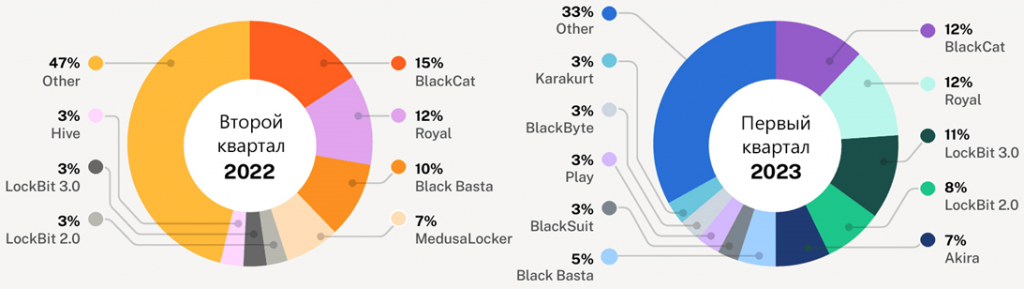
Extortion gang statistics for 2022 and 2023
May, according to the Coalition, was a particularly active month, with the largest number of insurance claims due to ransomware attacks in the company's history.
"After 18 months of declining activity, extortion already seemed like a relic of the past," the report's authors write. "However, the recent increase in both the frequency and severity of insurance claims suggests that cybercriminals are not ready to abandon such high-yield attacks."
Ransomware victims reported an average loss of more than $365,000, which is significantly higher than the previous record of more than $227,000 recorded in the second half of last year.
While it's usually impossible to determine exactly how much companies have paid ransomware groups, the Coalition's data helps us understand the scale and frequency of payments. The average foreclosure request among insurance company customers was $1.62 million, up 74% from a year ago.
According to the report, 36% of Coalition customers who encountered an attack paid the ransom "under reasonable circumstances and necessity," and through negotiations, the amounts decreased to an average of 44% of the original amount demanded by the attacking group.
Large companies with annual revenues of more than $100 million suffered the greatest losses due to a surge in such attacks, which immediately led to an increase in the amount of insurance payments by more than 70%.
Fraud in the transfer of funds also attracted the attention of Coalition analysts. In the first half of the year, the number of such cases increased by 15%, and the severity increased by 39%, reaching an average damage of almost $300,000. However, this amount is still below the record $410,000 in the first half of 2021.
"The increasingly sophisticated tactics of cybercriminals contribute to increasing the severity of damage caused by fraud when transferring funds," the authors of the report write.
"The longer attackers stay in email after a breach, the more difficult it is to detect their interference and report freelance activity. Apparently, hackers are willing to wait longer and longer for the right moment to redirect large payments."
A positive point in the Coalition's statistics is a decrease in the number of requests related to business mail compromise (BEC). Their frequency decreased by 15% and severity by 7% compared to last year, reaching an average loss of $21,000.
As the frequency and cost of cyber attacks increases, so does the size of the cyber insurance market. Insurance group Howden recently even predicted that the cyber insurance market will grow to $50 billion by 2030.
In the first half of 2023, the number of applications for cyber risk insurance increased significantly due to the explosive growth of ransomware attacks, as reported in a recent report by the Coalition agency specializing in cyber insurance.
The study found that ransomware was "the main driver of the increase in the frequency of insurance applications," which increased by 12% compared to last year. Overall, ransomware was associated with almost one in five cyberattacks resulting in insurance payouts, with the most common variants being malware from Royal, BlackCat, and LockBit.
Extortion gang statistics for 2022 and 2023
May, according to the Coalition, was a particularly active month, with the largest number of insurance claims due to ransomware attacks in the company's history.
"After 18 months of declining activity, extortion already seemed like a relic of the past," the report's authors write. "However, the recent increase in both the frequency and severity of insurance claims suggests that cybercriminals are not ready to abandon such high-yield attacks."
Ransomware victims reported an average loss of more than $365,000, which is significantly higher than the previous record of more than $227,000 recorded in the second half of last year.
While it's usually impossible to determine exactly how much companies have paid ransomware groups, the Coalition's data helps us understand the scale and frequency of payments. The average foreclosure request among insurance company customers was $1.62 million, up 74% from a year ago.
According to the report, 36% of Coalition customers who encountered an attack paid the ransom "under reasonable circumstances and necessity," and through negotiations, the amounts decreased to an average of 44% of the original amount demanded by the attacking group.
Large companies with annual revenues of more than $100 million suffered the greatest losses due to a surge in such attacks, which immediately led to an increase in the amount of insurance payments by more than 70%.
Fraud in the transfer of funds also attracted the attention of Coalition analysts. In the first half of the year, the number of such cases increased by 15%, and the severity increased by 39%, reaching an average damage of almost $300,000. However, this amount is still below the record $410,000 in the first half of 2021.
"The increasingly sophisticated tactics of cybercriminals contribute to increasing the severity of damage caused by fraud when transferring funds," the authors of the report write.
"The longer attackers stay in email after a breach, the more difficult it is to detect their interference and report freelance activity. Apparently, hackers are willing to wait longer and longer for the right moment to redirect large payments."
A positive point in the Coalition's statistics is a decrease in the number of requests related to business mail compromise (BEC). Their frequency decreased by 15% and severity by 7% compared to last year, reaching an average loss of $21,000.
As the frequency and cost of cyber attacks increases, so does the size of the cyber insurance market. Insurance group Howden recently even predicted that the cyber insurance market will grow to $50 billion by 2030.

