
Brother
Professional
- Messages
- 2,590
- Reaction score
- 533
- Points
- 113
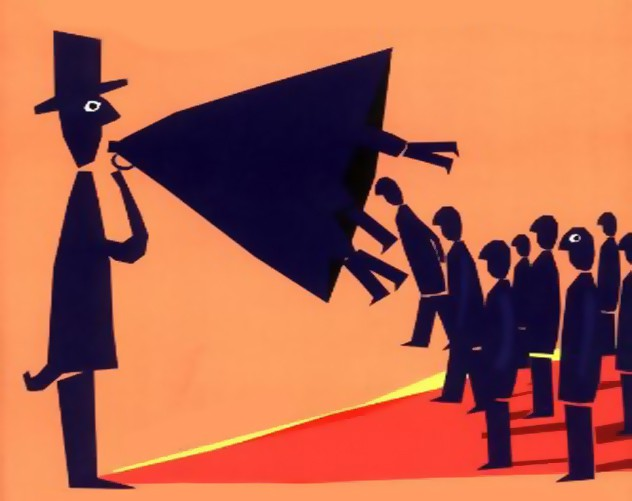
Large masses of people cannot live without appropriate control mechanisms. In the past, the management of mass activity was easier (in this regard, for example, religion also worked), since the world was more stable, therefore its model (picture) was also constant and fixed. Today the world is in dynamics and this requires more sophisticated management methods that would take into account this dynamics, as well as the fact of a greater variety of permitted options for human behavior. Those. the past stages with one variant of behavior and established views of the world are from these positions simple and easy to control the mass consciousness.
Humanitarian technologies that do this do not analyze or produce texts, they produce life, since they have as their goal to change behavior. It is this kind of adaptation that allows humanity to move forward. In this regard, even drama can be considered a humanitarian technology, since in this way social information about the interaction of people is transmitted. And here we can recall the “rise” of specific authors during perestroika (for example, M. Shatrov).
Each entry into the history of either a person or any object always brings a change in behavior as a consequence. The Impressionists, for example, not only used new equipment (a new type of easel and brush), they had a new vision, which at the same time brought new content, since people of other professions and other situations were portrayed. This is the entry of counter-society, as one of the researchers writes (Nord PG Impressionists and politics. Art and democracy in the ninerteenth century. - London, 2000). He also writes of what was then France (p. 59): “The republican society of the time was marked by a friendly attitude towards prominent members of the French religious minorities. The regime's enemies even denigrated it as a result of Protestant, Masonic and Jewish influences. The new artists were the chroniclers of the republican scene. So it was not unexpected
It should be added here that they not only reflected, but also influenced this society by their reflection. Let's remember how the rejection of their works and salons caused scandals and discussions. They all the time fell into the focus of attention, albeit negative, but still attention.
Baudelaire, with his texts and his interest, is considered the ideological inspirer of impressionism. This can be seen from the impact on each of them, especially E. Monet (Perrusho A. Life of Manet. - M., 1988). That is, again we can see another line of influence. The next link is created, to which this influence is transferred: one person (one text) per group, and the group - to the whole society.
But this group must have its own technology for organizing the masses of people. Al-Qaeda terrorists can also be analyzed from this angle. They have text that organized them. This is the text of S. Qutba, which is now being studied even by the American military. And the organizational technology, albeit a specific one, has become terror. Impressionists carry their influence through paintings, terrorists through explosions.
We have the following transition option:
New Ideology - New Technology - Mass Influence
The Strugatskys are also considered as a variant of the formative texts for Gaidar-Chubais and their team of young reformers ( Kurginyan S. Esau and Jacob. The fate of development in Russia and in the world. - T. 2. - M., 2009 ). It was they who introduced this ideology of experimentation over society, which was implemented in the post-Soviet space.
Coco Chanel is another such example. In a New York Times article, she is called "the mother of reinvention." The status of the fashion industry is so high that it was almost the only industry that the Nazis wanted to keep in France.
What did Coco Chanel come up with? This question was answered by one of her competitors - she offered a suite for the poor. This idea of fashion for the poor is clear from her main invention, the little black dress. The poor (of course, conditional), or rather the broad masses of people, were close to fashion, that is, this was also a new behavior for them.
Chanel introduced a new lifestyle for a young woman, this modern woman is called garcon. This woman wears short clothes, has many lovers and never gets married, she can drive like a man. This is a model of today's modern woman who has a lifestyle that is independent from men.
By the way, Chanel herself had not very correct behavior during the war. She not only made a lover, a German officer, but also went to Berlin to talk with Schellenberg and Himmler to discuss a plan for how to influence Churchill, whom she personally knew. The Stink of Spirits is the title of a book review that reveals Chanel's behavior during the Nazi occupation.
From the point of view of the French, she was a “horizontal collaborator,” that is, she was a woman who had a relationship with a German. Her lover, Baron Hans Gunther von Dinklage, was a real spy. His task was precisely to recruit rich Frenchmen, turning them into informants for the benefit of Germany. True, the books portray him simply as an "Aryan playboy." Chanel was agent F-7124, which was codenamed Westminster (see here and here).
Chanel not only opposed the Jews, but also tried to take advantage of the fact that the Germans took their property. Her Chanel No. 5 perfume was produced and owned by the Werthmeiers, who were a wealthy Franco-Jewish family. But during the war, while they emigrated to the United States, they managed to transfer ownership to the French. In 1947, they rewrote the 1924 contract that gave Chanel 2 percent of all Chanel's No. 5 sales worldwide. And this alone gave her millions of dollars.
In an interview with the New Yorker, the author of the book about the "collaborationist" says that his book was published in America, Great Britain, Germany, the Netherlands, but not in France. The French do not want to know this truth.
A third example of the introduction of new behavior is the history of the emergence of department stores. During this period, manufacturers entered mass production, they now needed mass consumption. As a result, it became necessary to attract as many buyers as possible. There is a loan that allows a person to make a purchase anyway without a sufficient amount of money.
Then, by the way, this organization of mass buying was repeated in the United States in the creation of supermarkets for the sale of groceries under the new rules in the thirties, where there was more choice, cheaper prices and parking places. This was all an example of aggressive marketing. We can also recall again the scandals that accompanied the entry of the Impressionists into academic salons.
The department store as a social institution is seen as a means of "liberating" women. They got the opportunity to buy, and this was completely new because it was a change in values, since before that a woman could only appear in a park or in a museum. Department also stores provided jobs for women. That is, it was a real generator of new behavior. Even skyscrapers are emerging as a response to the need for such stores. The general conclusion is this: department stores have changed the whole lifestyle, not just the forms of buying and selling.
If the Americans see the cradle of such department stores in themselves, then the French call it the first department store, which was created by the entrepreneur A. Bousico... The researchers believe that the creation of department stores was also prompted by the fact that rents in the central areas were two to three times higher, so the buildings had to go up or underground. In addition, Boucico had a different idea of selling than it was in the standards of the time: his small margin through cheaper prices had to be compensated for by large sales volumes. He added to that a fixed price, not a bargaining power. The new should include free admission without the obligation to buy something; he also introduced the practice of returning goods and getting money back. That is, the Busiko department store has laid a different option for interaction with the buyer. In today's words, we can say that he has become a buyer.
In these three examples, we see a fundamental impact on mass consciousness, which results in new types of behavior, which the following table can reflect:
In the latter case, by the way, as a consequence, a consumer society emerges, since consumption becomes massive. All these innovators had their own technology of survival in difficult conditions, which allowed them to move from defeat or a series of defeats to success.
We have our own examples of this behavior change. During perestroika, we saw the main strategic campaign for the transformation of Soviet values, which was unfolding, paradoxically, under the banner of Leninism. It can be seen in the speeches of M. Gorbachev, as well as two tactical campaigns - anti-alcohol and against the speech of N. Andreeva "I can not compromise principles" (1988). Gorbachev launched serious anti-propaganda against this article. D. Yazov recalls the meeting of the Politburo at which this article was discussed.
What was the secretary general Gorbachev afraid of when he launched such a serious campaign against the professor's article? For example, he demanded from each member of the Politburo to express their attitude to this article. In general, the situation was not so simple, since Gorbachev stopped the opportunity to accuse Yakovlev of the fact that, according to the KGB, he turned out to be an agent of CIA influence, therefore he was recruited along with A. Kalugin while studying at Columbia University (see here and here).
Former head of Soviet television L. Kravchenko also calls A. Yakovlev and E. Shevardnadze the main destroyers of the USSR. Moreover, he emphasizes that the clash between Azerbaijan and Armenia was artificial. By the way, about the employees of the well-known Vzglyad program, he says that every second person had a special service ID in his pocket.
Restructuring leads to a change in both values and behavior. Interestingly, it also highlights the vehicles of new values. Similarly, the Americans today are conducting not only military but also value campaigns in Afghanistan or Iraq. There are clear estimates of the success / failure of these campaigns. For example, for Afghanistan they have the following data ( Assesing military information operations in Afghanistan, 2001 - 2010. - Santa Monica, 2012 / RAND ):
Assessing Key Topics in Psychological Operations in Afghanistan
The mass consciousness is rather inertial, so such campaigns to change it take a lot of time and resources. Especially when this campaign is associated with the enemy.
But at the same time, not only standard ways work, but also non-standard ones. For example, video games, which also carry the potential for change that are being implemented in the mass consciousness. Obama, in connection with the "epidemic" of murders in the United States, even asked to test the effect of video games on the activation of aggressiveness (see here and here). On the whole, this can also be a reaction of the mass consciousness to the tension of the modern world. After all, the question often arises as to what kind of drugs the killer used.
During the Industrial Revolution in the UK, gin consumption skyrocketed as a stress-relieving technology. The current version of this technology is the consumption of television products. The 2011 data speaks of a daily 4 hours of watching TV for English citizens.
Many such patterns of behavior, which seem to us eternal, were actually introduced into society not so long ago. Tea became fashionable in England after Charles II married the daughter of the Portuguese king, who brought with her a new habit of drinking this drink. The British East India Company made it cheap. In 1717, the first tea shop was opened, aimed specifically at women with the understanding that they can promote tea in society. Women at that time could not go to cafes, but here they could drink tea. And it became the first public place for women.
Tea advertisements provided up to 50% of newspaper revenues, as a result of which tea worked to support the press. Before that, tea became the target of the first PR - the Dutch East India Company hired a Danish doctor who wrote many articles on the medicinal properties of tea to promote it in Europe. Tea also supported the first industrial revolution in England, because the workers drank tea to stay awake, because they were working with machines for the first time, and there you had to be very careful.
Mass behavior and especially its new forms require a variety of support. The inertia of the past does not allow for easy transition to the new. Therefore, new behavior enters life only with the help of additional means.