


Tomcat
Professional
- Messages
- 2,695
- Reaction score
- 1,063
- Points
- 113
Reports have surfaced that hackers are demanding $ 7.5 million in Monero following an attack on Telecom Argentina SA, a major telecommunications provider serving the northern region of the country.
Anonymous sources say the cyberattack has been ongoing since Wednesday.
At first, employees attributed the low performance of the IT infrastructure to system failures. But then, as a result of research carried out by the company's technical support service, there were requests not to open files, not to use e-mail, and even to disconnect the terminals from the system.
"[the employees] had problems accessing the corporate VPN, as well as the Siebel system, where they had access to the Personal, Arnet, Telecom and Fibertel databases."
An analysis of the situation showed that the attack began due to the attachment "77os97-readme" attached to the letter.
This comes after the recent Twitter hack, in which hackers hijacked the accounts of famous personalities to trick unsuspecting people into Bitcoin.
In this regard, the focus is again on cryptocurrency and its relationship to crime. But more than that, the role of private coins in promoting crime.
They demanded Monero to end the cyberattack
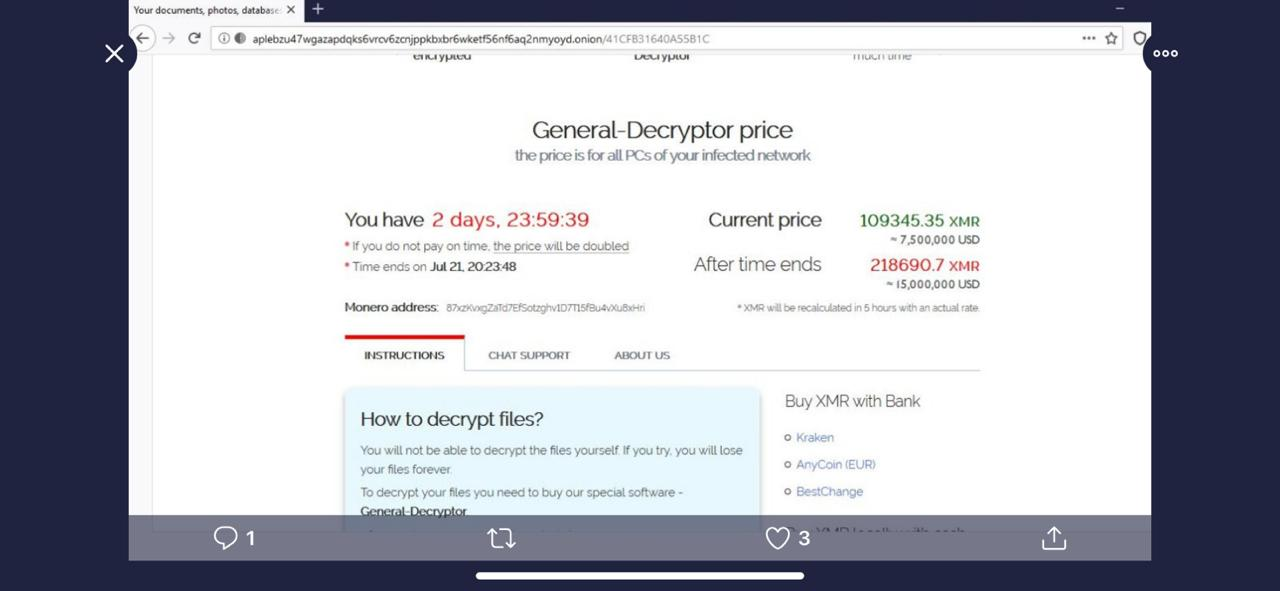
Economist Alex Kruger posted a screenshot on Twitter today demanding the attackers in exchange for stopping the cyberattack.The screenshot shows the amount of 109 thousand Monero, equivalent to $ 7.5 million, due to be paid by July 21st. Failure to pay on time will result in a doubling of this amount.
The incident sparked a mixed reaction from the crypto community. Some see this as proof of the benefits of Monero in that it is the # 1 private coin, able to protect the identity of intruders.
Others see this as a bearish factor for cryptocurrencies in general, as it gives rise to further industry restrictions.
Even before this hack, private coins were already under target for being "the choice of criminals." But this latest incident provides the authorities with the leverage they need to impose tougher rules.
Balancing between freedom and privacy
Privacy was back on the agenda after the attack on Telecom Argentina SAThe fact that hackers have demanded Monero underscores how little privacy exists in today's world.
It reminds us that "big technology", in collusion with governments around the world, is struggling to infiltrate all aspects of our lives.
Futurist Daniel Jeffries described a gradual movement towards a community with constant surveillance, where cash is dead and private coins are our only means of achieving freedom.
“Your phone knows where you are going, who your friends are and what you want to buy before you do it. Centralized digital money will know even more."
His fundamental argument focuses on the fact that the desire for seclusion is different from the crime. Instead, he argues that privacy is more about the freedom to have different opinions, all without the control of those who disagree.
“None of us wants our personal life to go on the air. In the same way that we don't want neighbors looking out the windows when we walk naked, and someone eavesdropping when we whisper nice things to our lover, we don't want some cold-blooded bureaucrat or corporation to anonymously track every second of every day of our life."
Therefore, calls for a ban on the use of private coins are not as black and white as the authorities might seem at first glance. Indeed, in the future, private coins may be the only way to preserve our freedoms.


