

Carding
Professional
- Messages
- 2,870
- Reaction score
- 2,522
- Points
- 113
The ransomware arrow points to the Japanese company's big cybersecurity issues.
The Japanese company Seiko, the world leader in luxury watches, has come under a ransomware attack by the notorious hacker group BlackCat (aka ALPHV).
On August 10, Seiko released a statement about the hacking of its systems, stating that attackers gained unauthorized access to part of the company's IT infrastructure and stole confidential data. The break-in itself is believed to have taken place on July 28.
On August 2, a team of external cybersecurity experts was brought in to investigate the incident. The results of the analysis showed that there was indeed a data leak from the servers of Seiko and affiliated companies.
Seiko apologized to potentially affected customers and partners and urged them to be vigilant against fraudulent emails and other suspicious communications on behalf of the company.
Yesterday, the hacker group BlackCat published on its leak site samples of data stolen from Seiko.
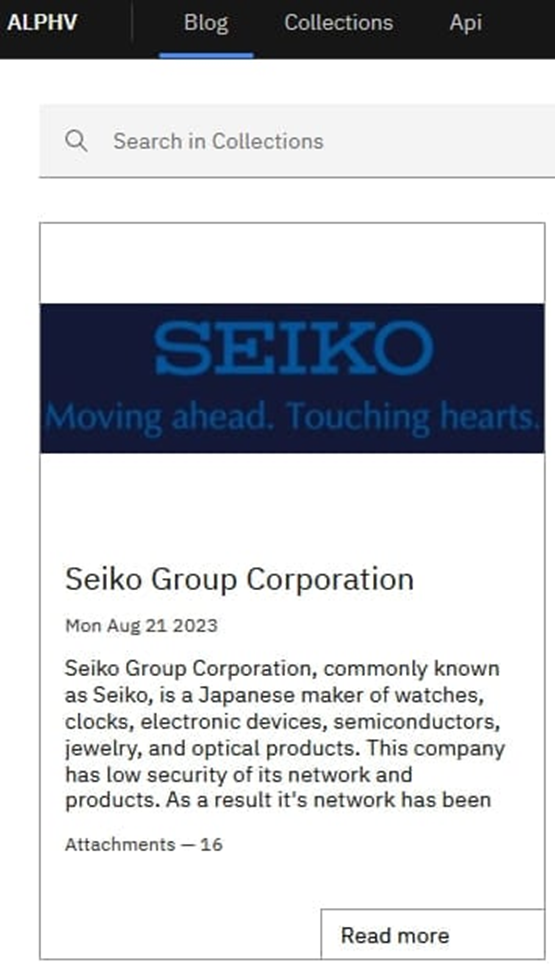
The attackers ridiculed the company's IT security and said they had obtained production plans, employee passports, information about upcoming watch models, and specialized lab test results.
However, the most valuable find of the hackers was the secret drawings and sketches of current and future Seiko watches. The publication of this confidential data will cause significant image and financial damage to the company, since unscrupulous competitors will be able to copy the company's patented technologies.
The BlackCat group has long been known as one of the most dangerous hacker syndicates, specializing in ransom attacks on large companies. Malefactors constantly improve the methods of extortion and blackmail.
For example, BlackCat was the first to create a site for publishing stolen data in the public domain, without the use of onion routing, to facilitate the distribution of stolen information.
Notably, according to researchers at Curated Intel, the initial network access of an unnamed $1.8 billion Japanese manufacturing firm was being sold on the dark web as early as July 27, the day before Seiko announced the date of the hack.
Although the name of the company was not revealed in the announcement, its description is fully consistent with Seiko's profile. This suggests that BlackCat hackers gained access to the company's infrastructure through the services of remote access brokers (IAB) in order to then independently attack target systems and steal valuable data.
The Seiko hacking incident once again demonstrates the growing sophistication and determination of modern hackers. Large companies need to radically revise their approaches to protecting confidential data and intellectual property in order not to fall into the list of the next victims of cybercriminals.
The Japanese company Seiko, the world leader in luxury watches, has come under a ransomware attack by the notorious hacker group BlackCat (aka ALPHV).
On August 10, Seiko released a statement about the hacking of its systems, stating that attackers gained unauthorized access to part of the company's IT infrastructure and stole confidential data. The break-in itself is believed to have taken place on July 28.
On August 2, a team of external cybersecurity experts was brought in to investigate the incident. The results of the analysis showed that there was indeed a data leak from the servers of Seiko and affiliated companies.
Seiko apologized to potentially affected customers and partners and urged them to be vigilant against fraudulent emails and other suspicious communications on behalf of the company.
Yesterday, the hacker group BlackCat published on its leak site samples of data stolen from Seiko.
The attackers ridiculed the company's IT security and said they had obtained production plans, employee passports, information about upcoming watch models, and specialized lab test results.
However, the most valuable find of the hackers was the secret drawings and sketches of current and future Seiko watches. The publication of this confidential data will cause significant image and financial damage to the company, since unscrupulous competitors will be able to copy the company's patented technologies.
The BlackCat group has long been known as one of the most dangerous hacker syndicates, specializing in ransom attacks on large companies. Malefactors constantly improve the methods of extortion and blackmail.
For example, BlackCat was the first to create a site for publishing stolen data in the public domain, without the use of onion routing, to facilitate the distribution of stolen information.
Notably, according to researchers at Curated Intel, the initial network access of an unnamed $1.8 billion Japanese manufacturing firm was being sold on the dark web as early as July 27, the day before Seiko announced the date of the hack.
Although the name of the company was not revealed in the announcement, its description is fully consistent with Seiko's profile. This suggests that BlackCat hackers gained access to the company's infrastructure through the services of remote access brokers (IAB) in order to then independently attack target systems and steal valuable data.
The Seiko hacking incident once again demonstrates the growing sophistication and determination of modern hackers. Large companies need to radically revise their approaches to protecting confidential data and intellectual property in order not to fall into the list of the next victims of cybercriminals.
