


Carding Forum
Professional
- Messages
- 2,788
- Reaction score
- 1,323
- Points
- 113
Citizenship by Investment programs allow wealthy people to not only diversify their portfolios, but also get a new passport, and with it the benefits of another country's citizenship. We figured out how CIP programs work and how much they cost
For most people in the world, the coronavirus pandemic and quarantine restrictions mean fewer travel opportunities. But this is not the case for super-rich families, who are increasingly using their savings to move around the world. We are talking about investment migration, which implies obtaining a parport not on the basis of nationality or citizenship, but on the basis of the size of the state.
The so-called Citizenship by Investment (CIP) is currently a growing industry, as is the Residence by Investment Permit, also known as Golden Visas. For very wealthy people, this is a way not only to diversify their portfolio by transferring money to another country, but also the opportunity to get a new passport, and with it the benefits of citizenship of another country.
CIP programs are usually used by people with between $ 2 million and $ 50 million. Over the past 5-10 years, their main motives have been freedom of movement, tax breaks, better education or civil liberties. But with COVID-19, wealthy people are increasingly looking at countries in terms of pandemic response, health care level and potential shelter, in order to have a "plan B" in the event of a new lockdown.
“People really want to have alternative citizenship insurance as a 'plan B'. They are also concerned about health and pandemic preparedness because obviously this may not be the only pandemic in our lives, ”said Head of Asia at Henley & Partners. According to him, wealthy people do not plan for five to ten years - they plan more than 100 years ahead in terms of wealth and well-being.
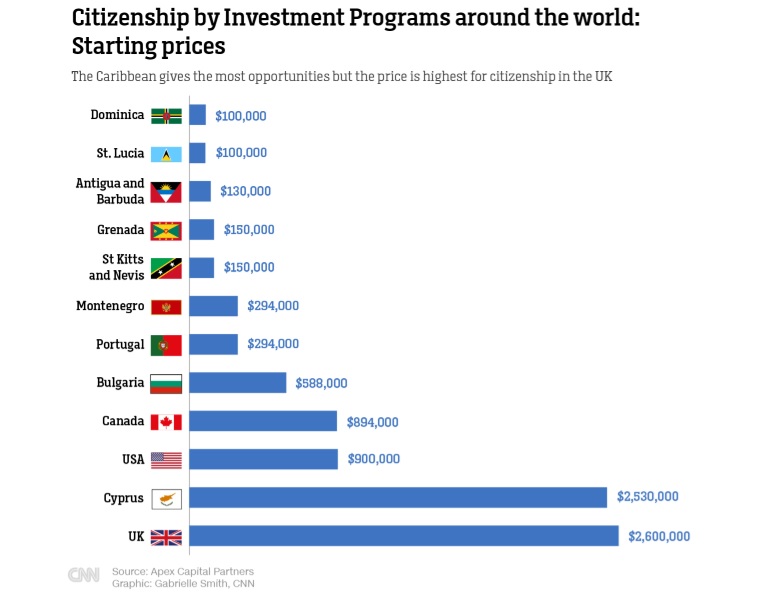
The cost of citizenship by investment programs in different countries.
Residency programs in Australia and New Zealand are also in high demand, but for a different reason - crisis management. New Zealand came out on top in terms of how the country coped with the pandemic, compared to some other usually preferred countries like the UK or the US.
Families with very high income levels are eligible to participate in housing programs. For example, Australian citizenship costs $ 1-3.5 million, New Zealand - $ 1.9-6.5 million. Citizens of China and the Middle East traditionally become clients of CIP programs. The number of applications from Americans, Indians, Nigerians and Lebanese has also increased significantly over the past nine months. In particular, the number of applications from US residents increased by 700% in the first quarter of 2020 compared to the last quarter of 2019.
Experts point to another trend - investing in new passports to circumvent travel bans in the future. Given the quarantine restrictions, a number of countries allow only holders of certain passports into their territory - for example, Europeans cannot visit the United States, and vice versa. However, the holder of a Cypriot passport can travel within the EU. Therefore, people use their savings to arrange the lifestyle they want.
The first CIP was introduced in 1984 on the islands of Saint Kitts and Nevis in the Caribbean. Since then, dozens of countries have established such programs, including Austria, Cyprus, Malta, Moldova, Turkey, Antigua and Barbuda, Dominican Republic, Greece, Montenegro and many others. Some countries require job seekers to set up non-profit organizations, companies that create jobs locally, or reside in the country for a certain amount of time. Others allow applicants to remotely invest in government bonds, real estate, and development projects.
Depending on the country, these programs can cost from $ 100,000 in Antigua and Barbuda to $ 250,000 in Saint Kitts and Nevis, $ 280,000 in Greece, $ 1.1 million in Malta and $ 2.4 million in Cyprus. Portugal, for example, is one of the most attractive countries, since the price of 350-500 thousand euros is acceptable for wealthy people. For this, they receive a residence permit, visa-free access to the Schengen countries, as well as a clear path to citizenship after five years of residence and knowledge of Portuguese at an elementary level. And if clients have enough financial capabilities, they choose Malta or Cyprus, immediately receiving EU citizenship.
Saint Kitts is a popular Caribbean country for CIP applicants.
Consulting agencies estimate that about 5,000 people obtained citizenship abroad through CIP programs in 2017. In 2020, according to preliminary estimates, their number may reach 25,000. However, one should not think that obtaining citizenship or a residence permit by investment is so easy and quick. These programs take time. No oligarch can hand over a million dollars to some politician and leave with a passport.
The due diligence process can take from several months to several years, depending on the country. Typically, candidates go through rigorous financial and criminal due diligence to make sure the money was legitimately earned. The applicant is required to disclose his own capital and source of funds, as well as provide certificates of no criminal record in his country of birth, country of citizenship and wherever he has lived for more than six months in the last 10 years. And even after all the procedures, the application may be rejected. For example, in Malta the bounce rate is 20-25%.
The CIP has many supporters. However, many experts also criticize these programs. For example, in 2018, Transparency International, a global coalition against corruption, criticized citizenship and residence by investment schemes in Malta, Cyprus, Portugal and Spain, claiming that these programs "sell access to the Schengen area" and even EU citizenship for foreign investors with questionable transparency of the verification process. And some blame CIP programs for exacerbating inequalities. Like, such programs provide special privileges to the already privileged. Nevertheless, the opportunity to obtain a country's passport in exchange for investment in its economy is gaining popularity, providing people, first of all, with additional freedom.
For most people in the world, the coronavirus pandemic and quarantine restrictions mean fewer travel opportunities. But this is not the case for super-rich families, who are increasingly using their savings to move around the world. We are talking about investment migration, which implies obtaining a parport not on the basis of nationality or citizenship, but on the basis of the size of the state.
The so-called Citizenship by Investment (CIP) is currently a growing industry, as is the Residence by Investment Permit, also known as Golden Visas. For very wealthy people, this is a way not only to diversify their portfolio by transferring money to another country, but also the opportunity to get a new passport, and with it the benefits of citizenship of another country.
CIP programs are usually used by people with between $ 2 million and $ 50 million. Over the past 5-10 years, their main motives have been freedom of movement, tax breaks, better education or civil liberties. But with COVID-19, wealthy people are increasingly looking at countries in terms of pandemic response, health care level and potential shelter, in order to have a "plan B" in the event of a new lockdown.
Plan b
Citizenship by investment applications increased 42% between January and June 2020 compared to the same period in 2019, according to global citizenship and residence consultancy Henley & Partners . Experts are confident that the increased interest in CIP is associated with the coronavirus, problems with health systems and doomsday forecasts.“People really want to have alternative citizenship insurance as a 'plan B'. They are also concerned about health and pandemic preparedness because obviously this may not be the only pandemic in our lives, ”said Head of Asia at Henley & Partners. According to him, wealthy people do not plan for five to ten years - they plan more than 100 years ahead in terms of wealth and well-being.
Which countries are in demand and how much does it cost
As for specific citizenship programs, the most popular are Montenegro and Cyprus - the number of new applications in these countries grew by 142% and 75%, respectively, in the first quarter of 2020. There is also an ongoing interest in Malta. These countries provide the applicant and his family with access to a better education and health care system, as well as the ability to travel throughout the European Union.
The cost of citizenship by investment programs in different countries.
Residency programs in Australia and New Zealand are also in high demand, but for a different reason - crisis management. New Zealand came out on top in terms of how the country coped with the pandemic, compared to some other usually preferred countries like the UK or the US.
Families with very high income levels are eligible to participate in housing programs. For example, Australian citizenship costs $ 1-3.5 million, New Zealand - $ 1.9-6.5 million. Citizens of China and the Middle East traditionally become clients of CIP programs. The number of applications from Americans, Indians, Nigerians and Lebanese has also increased significantly over the past nine months. In particular, the number of applications from US residents increased by 700% in the first quarter of 2020 compared to the last quarter of 2019.
Hide from COVID-19
Some wealthy people are turning to citizenship by investment programs in an effort to find a safe and secluded place to hide with their families in the event of a new coronavirus outbreak. Now it is increasingly said that small countries are easier and more effective in coping with a pandemic. If in the United States the situation got out of control, then such Caribbean countries as the Dominican Republic, Antigua and Barbuda or Saint Kitts recorded very few cases of COVID-19 infection. In addition, small island states provide relatively inexpensive CIP programs and freedom of movement. So if your net worth is roughly $ 1 million to $ 5 million or $ 10 million, then the Caribbean is a great choice.Experts point to another trend - investing in new passports to circumvent travel bans in the future. Given the quarantine restrictions, a number of countries allow only holders of certain passports into their territory - for example, Europeans cannot visit the United States, and vice versa. However, the holder of a Cypriot passport can travel within the EU. Therefore, people use their savings to arrange the lifestyle they want.
Investment migration: how it works
Investment migration programs offer residency or citizenship in exchange for significant investment in a country's economy, usually in the form of real estate, job creation, infrastructure development, or government bonds.The first CIP was introduced in 1984 on the islands of Saint Kitts and Nevis in the Caribbean. Since then, dozens of countries have established such programs, including Austria, Cyprus, Malta, Moldova, Turkey, Antigua and Barbuda, Dominican Republic, Greece, Montenegro and many others. Some countries require job seekers to set up non-profit organizations, companies that create jobs locally, or reside in the country for a certain amount of time. Others allow applicants to remotely invest in government bonds, real estate, and development projects.
Depending on the country, these programs can cost from $ 100,000 in Antigua and Barbuda to $ 250,000 in Saint Kitts and Nevis, $ 280,000 in Greece, $ 1.1 million in Malta and $ 2.4 million in Cyprus. Portugal, for example, is one of the most attractive countries, since the price of 350-500 thousand euros is acceptable for wealthy people. For this, they receive a residence permit, visa-free access to the Schengen countries, as well as a clear path to citizenship after five years of residence and knowledge of Portuguese at an elementary level. And if clients have enough financial capabilities, they choose Malta or Cyprus, immediately receiving EU citizenship.
Saint Kitts is a popular Caribbean country for CIP applicants.
Consulting agencies estimate that about 5,000 people obtained citizenship abroad through CIP programs in 2017. In 2020, according to preliminary estimates, their number may reach 25,000. However, one should not think that obtaining citizenship or a residence permit by investment is so easy and quick. These programs take time. No oligarch can hand over a million dollars to some politician and leave with a passport.
The due diligence process can take from several months to several years, depending on the country. Typically, candidates go through rigorous financial and criminal due diligence to make sure the money was legitimately earned. The applicant is required to disclose his own capital and source of funds, as well as provide certificates of no criminal record in his country of birth, country of citizenship and wherever he has lived for more than six months in the last 10 years. And even after all the procedures, the application may be rejected. For example, in Malta the bounce rate is 20-25%.
The CIP has many supporters. However, many experts also criticize these programs. For example, in 2018, Transparency International, a global coalition against corruption, criticized citizenship and residence by investment schemes in Malta, Cyprus, Portugal and Spain, claiming that these programs "sell access to the Schengen area" and even EU citizenship for foreign investors with questionable transparency of the verification process. And some blame CIP programs for exacerbating inequalities. Like, such programs provide special privileges to the already privileged. Nevertheless, the opportunity to obtain a country's passport in exchange for investment in its economy is gaining popularity, providing people, first of all, with additional freedom.

