
Papa Carder
Professional
- Messages
- 356
- Reaction score
- 277
- Points
- 63
Overview of NFC Skimming Attacks
NFC (Near Field Communication) skimming attacks refer to unauthorized attempts to read or intercept data from contactless devices, such as payment cards, smartphones, or passports, using NFC technology. Operating under standards like ISO/IEC 14443, NFC enables short-range (typically <10 cm) wireless data exchange, but attackers exploit this for fraud. Traditional skimming involves passively capturing static data like card numbers, but modern variants — driven by EMV's dynamic security — have evolved into more sophisticated methods like relay attacks and malware-assisted theft. As of 2026, with contactless payments exceeding 80% global adoption, these attacks pose significant risks, though classic passive skimming has <1% success rate due to encryption and tokenization.While often conflated with relay attacks (from previous discussions), skimming focuses on data extraction rather than real-time forwarding. However, boundaries blur in practice, as many "skimming" incidents involve relays or emulation. The threat is primarily physical, requiring proximity, and is "damn near impossible" over the internet alone.
Types of NFC Skimming Attacks
NFC skimming can be categorized into traditional and advanced forms:- Traditional Passive Skimming:
- How it Works: An attacker uses a portable NFC reader (e.g., PN532 module, modified smartphone, or devices like Flipper Zero) to capture radio waves emitted by a victim's card or phone when in close range. Data like card number (PAN), expiration date, and sometimes CVV is read without interaction.
- Limitations: Ineffective against EMV cards due to dynamic cryptograms (e.g., ARQC) and tokenization, which render static data useless for transactions. No billing address or full authentication details are captured. Success rate is low (<1%), making it non-viable for most criminals compared to easier methods like phishing.
- Relay-Based Skimming (e.g., NFC Relay, NFCGate):
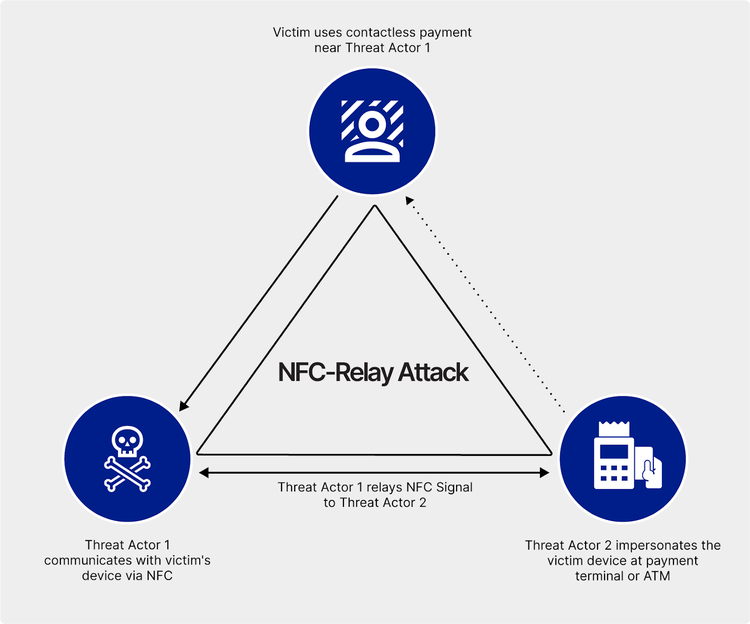
- How it Works: Involves two devices: one near the victim captures NFC signals (e.g., via a rogue reader or malware-infected phone), relaying them in real-time over the internet (Bluetooth, Wi-Fi, or cellular) to a second device at a POS terminal or ATM. NFCGate, originally a 2015 open-source research tool for traffic analysis, has been weaponized since 2023 for malicious relays. Direct relays trick victims into tapping cards on infected phones; reverse relays use the victim's phone to emulate the attacker's card for fund transfers. Success rate: 3-7%.
- Diagram Illustration:
- Malware-Assisted Skimming (e.g., PhantomCard, SuperCard X, Ghost Tap):
- How it Works: Malware like PhantomCard (based on Chinese NFU Pay MaaS) disguises as a "card protection" app, prompting users to tap cards for "verification." It uses Android's NFC reader and ISO-DEP protocol to parse EMV data (e.g., via APDU commands like SELECT PSE), then relays it to attackers' servers. Ghost Tap employs Host Card Emulation (HCE) to mimic cards with stolen Track 2 data, forcing offline transactions below CVM limits. Tools like Z-NFC, Track2NFC, or RatOn add remote control, obfuscation, and device farms for scaling. Infections occur via fake app stores or phishing. Success rate: 3-6%.
Real-World Examples and Impacts
- NFCGate Variants: First seen in Czech Republic (2023), with over 80 samples by 2025; integrated into MaaS like SuperCard X (Italy, Russia, Brazil) and RatOn. Used for ATM withdrawals and POS fraud.
- Ghost Tap Evolution: From NFCgate (2020) to Track2NFC (2024), causing millions in U.S. losses in Q1 2025; targets high-adoption regions like MENA (98% contactless in Saudi Arabia). Enables loyalty point theft and money laundering.
- PhantomCard: Emerging in Brazil (2025), relays data for global use; transactions appear legitimate but flagged by metadata mismatches.
- Impacts: Financial losses (e.g., drained accounts), delayed alerts, identity spoofing; scaled attacks via mules in China, Malaysia, Nigeria. Victims may not notice until funds are gone, with banks struggling to detect.
Prevention and Mitigation
While NFC skimming remains a threat, it's not as viable as hyped due to low ROI for attackers. Effective countermeasures include:- User Practices: Use RFID-blocking wallets/sleeves or aluminum foil to shield cards; store in front pockets; disable NFC when unused; keep multiple cards together to scramble signals. Never tap cards on phones per app requests; install apps only from official stores; verify bank contacts directly.
- Technical Protections: Set trusted apps (e.g., Google Pay) as default; use security software to block malware; enable biometrics for wallets. Banks should monitor metadata (e.g., geolocation, velocity) and enforce CVM limits, RTT checks, and watchlist screening.
- Systemic Measures: Retailers inspect terminals for tampering; opt for chip/contactless with tokenization; block cards if suspicious. Global cooperation to combat MaaS and Dark Web tools.
For the latest threats, as seen in 2026 Android issues, stay vigilant against fake apps combining skimming with other exploits. If implementing defenses, refer to EMVCo specs for enhanced protocols.

