


CarderPlanet
Professional
- Messages
- 2,549
- Reaction score
- 724
- Points
- 113
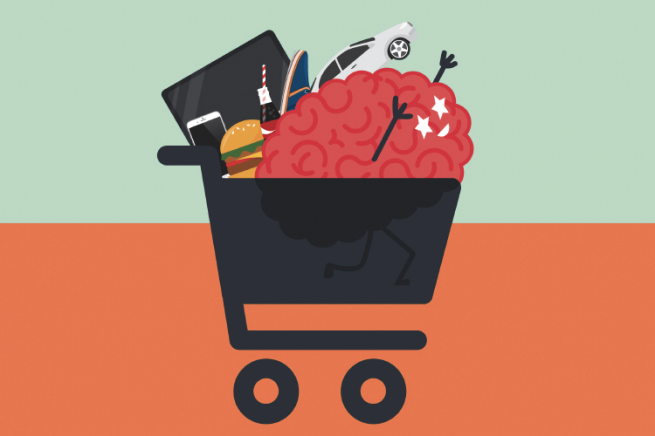
Loss aversion, priming effect, Baader-Meinhof phenomenon: selected 10 psychological effects that marketers actively use in the struggle for our attention.
Have you ever wondered why you bought another piece of clothing that you might never wear again at a sale at "just half price"? Or why do people spend half their salary on a new version of a smartphone, although they were quite happy with the old one? In the footsteps of publications for professional marketers, here are ten marketing hooks that we fall for over and over in the ocean of the consumer market.
1. Priming effect
Probably everyone has ever played a game in which one person says a word, and the other immediately answers the first association that comes to his mind? Games like Alias are based on a similar principle. As a rule, the use of such stable associations in the game as: "Tula ..." - gingerbread, "last ..." - a bell, works faultlessly.It's kind of like programming. You receive one signal, and it affects how you respond to the next. Psychology Today magazine cites the example of a study of two groups of people who read successively the words "yellow" and then either "sky" or "banana." Since humans have a semantic connection between the fruit and its color, the yellow-banana group recognizes the word banana faster than the yellow-sky group recognizes the sky.
How does marketing apply? For example, using this technique to select the background of a website can help website visitors remember key brand information - and perhaps even influence their buying behavior.
This has been tested previously. In a study by Naomi Mandel and Eric Johnson, scientists changed the background and design of a website to see how this might affect consumers' product choices [1]. Participants were asked to choose between two products of the same category (for example, between Toyota and Lexus). Researchers found:
“... visitors who were programmed for money (the website had a green background with dollars in the background) looked at price information longer than those who were programmed to be safe (the background was red-orange with a flame) ... Likewise, consumers who were programmed to be comfortable when choosing a sofa took longer to view information about the comfort of a sofa (the site was in blue with light clouds) than those who would have been programmed for money (green with dollars). "
2. The Baader-Meinhof phenomenon, or frequency illusion
Has it ever happened to you that when you first hear about something, you then begin to see it everywhere in your daily life? For this you can thank the Baader-Meinhof phenomenon. This starts to happen after the first encounter with something, and then you begin to notice this appearance around you. All of a sudden, you see an advertisement for a certain product every time you watch TV. And when you come to the store and walk along the counter, you accidentally find the same item. And ALL of your friends already have this product.Strange, isn't it? This phenomenon, which has another name - frequency illusion, is caused by two processes:
For marketers, this phenomenon is extremely important. Once you start to notice their brand, they want to help you see it “around the world”. And they start sending you targeted messages by e-mail, delivering targeted ads, so that you can make sure once again that you will not be able to escape their unobtrusive attention ...“First, selective attention dies when you are struck by a new word, thing, or idea. After that, you unconsciously track this object and as a result, find it surprisingly often. The second process is confirmation, which convinces you that every new appearance of a product in your life is another proof of your impression that the thing has become ubiquitous overnight. "
3. Bait effect
This effect is most commonly used in a pricing model - one pricing option is intentionally included to entice you to choose the most expensive option.In a TED talk "Do we control our own decisions?" (Dan Ariely "Are we in control of our own decisions?") Dan Ariely gives an example of The Economist magazine ads outlining the subscription package options on this magazine. Here's what they suggested:
- Internet subscription: $ 59
- Print subscription: $ 125
- Online and Print Subscription: $ 125
Dan Ariely also asked this question, but, having contacted The Economist, he, of course, did not receive a direct answer.
Therefore, he decided to conduct his own research with the participation of one hundred students. He gave them the price packages described above and asked which one they would like to buy. When all three options were presented to the students, the students opted for a combined subscription - that was the best deal, wasn't it? But when he ruled out the "nonsensical" option (with a print subscription for $ 125), the students opted for the cheapest option.
It turned out that the middle option was not so useless - it gave students a starting point to gauge how “good” the combined option was and convinced them to pay more for that option.
So, to achieve his goal, the seller can add any third option to the two main options, thereby increasing the chances of acquiring the product in which he is primarily interested in selling ...
4. Loss aversion
Loss avoidance, or “loss aversion,” means that after you have something, you really don't want to lose it.When Daniel Kahneman explored the concept, participants were given mugs, chocolates, or nothing. Then the participants were asked to make a choice: if they received an item, they could trade it, and if they did not receive anything, they could choose one of two options for items.
What was the result? Roughly half of the participants who started with nothing chose the mugs, but 86% of the people who got the mugs from the start got stuck with them, not wanting to sell them.
Morality? People don't like to lose what they have already gained.
This effect has been used successfully by marketers. For example, providing a free version of an IT product for a certain period of time. After the free time has expired, the application can be uninstalled if the buyer does not pay for further use.
5. Reciprocity
In Dr. Robert Cialdini's book Influence: The Psychology of Persuasion, reciprocity is presented in an extremely simple formula - if someone does something for you, you will naturally want to do something in the answer for him.If you've ever received chewing gum with your cafe or restaurant bill, you've been a victim of reciprocity. Cialdini said that when waiters bring a customer a check without chewing gum, the tip will inevitably be reflected in the perceived quality of service. With one gum, the tip increases 3.3%. Two peppermint gum? The tip can go up to 20%!
There are many ways in marketing to take advantage of reciprocity. At the same time, the seller does not have to go broke by providing you with valuable things for free. Anything can be a bonus - from a branded T-shirt to an exclusive book, free desktop wallpaper, or a collection of tips on something. Even something as simple as a handwritten card or note can be the key to establishing reciprocity. It is enough for the seller to give a free and most likely unnecessary thing to you, before asking for something more tangible in return.
6. Social impact
Most are already familiar with this concept, but it is too important to ignore. If you are not familiar with it, then according to the concept of informational social influence (or social proof, social proof) people tend to accept the beliefs or actions of the group of people whom they love most or whom they trust. In other words, this is the "me too" effect. Or the “dance floor” effect - few people want to be the first on the dance floor when the dancing is just beginning, but as soon as the first few people start dancing, the rest immediately join.The simplest way to use social influence is with the social media buttons below blog posts and websites. The number of re-posts speaks for itself, forcing a new reader to do the same, and having friends among the readers of a page or blog generates an irresistible desire to “join”.
7. Limited availability
Have you ever bought plane tickets online or booked a hotel and saw the warning signal “there are only 3 seats left at this price”? Yes, this is scarcity (another term that Dr. Cialdini uses). This principle of psychology goes back to the simple formula of supply and demand: the more rare an opportunity, content or product is, the more valuable it is.In 1975, Stephen Vorchel, Jerry Lee and Akanbi Adewal conducted a study to see how deficits affect our perception [2]. They asked people to rate the chocolate chip cookie. One jar held ten pieces of cookies, and the other just two.
Therefore, when advertising is replete with the words "exclusive", "limited edition" or "last offer", ask yourself what attracts you more - the product itself or your unique status as an exclusive owner.“The rating for cookies from a can, which had only two of them, was twice as high as the rating of cookies from another bank. The effect persisted even if the cookies in the jars were the same. "
8. Anchor effect
Why is it so hard to resist sales at your favorite clothing store?This is often due to the anchoring effect - people make decisions based on the first piece of information they receive. So, if your favorite store usually sells jeans for $ 50, but gives away for $ 35 on sale, then customers will be delighted. It is easy to get the feeling “I'm getting a crazy discount on these jeans!” Which will most likely lead to a purchase. But, for example, if a person usually buys jeans for $ 20, then this discount will not make such an impression on him.
The anchor effect is the most important move for marketers: they must clearly set an anchor - indicate the initial sale price, and then indicate the actual sale price next to it and indicate the percentage of savings (preferably - bright and catchy).
9. Verbal effect
According to a study by a group of scientists at the University of Ontario, people are more likely to remember the essence of what someone said, rather than specific details [3]. So, when you're attending a training session on how to best blog for your business, you'll likely remember details like “Send your article to someone for editing before publishing” rather than “Submit Google Doc three business days before publishing to colleagues so they can make changes to your work. Remember to make corrections in 'edit mode' so you know what you missed! 'Scientists have called this the “literal effect,” and it can have a huge impact on how content is perceived. It is known that people spend a small amount of time reading online, and on some sites they do not linger for more than 15 seconds.
This is why marketers focus on short, catchy headlines. If the title clearly reflects the content of the article, then you will remember its essence much faster, and later you can easily remember its title in order to find it again on Google.
10. Clustering (grouping)
People have a limited amount of short-term memory. Most of us can only remember seven pieces of information at a time (plus or minus two pieces in a given situation).To deal with this problem, most people tend to group similar pieces of information together. For example, if you had a whole shopping list of random items, then you tend to mentally group items into certain categories (dairy products, meat, etc.) in order to be able to better remember what exactly was on the list.
This is why marketers pay so much attention to content clustering. Grouping similar topics together - under numbered lists or with different heading sizes - allows us to better remember information.

