


Brother
Professional
- Messages
- 2,590
- Reaction score
- 533
- Points
- 113
After almost 60 years, it became known what the money of American taxpayers was spent on.
In the 1960s, America found it difficult to gather intelligence about foreign countries. Spy planes like the Lockheed U-2 provided high-quality images, but risked being shot down and provoked foreign governments. Photo-reconnaissance satellites were protected from anti-aircraft missiles and less provocative, but they transmitted data with a delay and gave low-quality images.
To solve such problems, the Manned Orbiting Laboratory (MOL) program was launched, which aimed to expand the capabilities of US military intelligence by combining two methods: the use of a manned spy satellite in space.
The MOL program was a joint project of the United States Air Force and the National Office of Military Space Intelligence, launched after the Cuban Missile Crisis of 1962, at the height of the Cold War and the Vietnam War. President Lyndon B. Johnson approved the project in August 1965, although it was presented as an operation to study human capabilities in space.As part of the MOL program, it was planned to receive high-quality photos of foreign opponents. The operator on board the satellite could determine in real time where and when to take a picture, bypassing visibility restrictions due to clouds and data transmission delays.
MOL assumed 6 launches with a flight duration of 2 to 4 weeks. The crew would consist of 2 people who would launch on a modified Gemini capsule and return to Earth after the mission, while MOL remained in orbit.
The main payload of MOL was a telescope for military intelligence, equipped with a mirror with a diameter of 182.8 cm and codenamed Dorian.
Criticism, delays, and budget overruns
Despite the public presentation of MOL as a mission to explore human capabilities in space, its main purpose was strictly classified.
The first and only launch of the MOL program occurred on the launch pad of Cape Canaveral Air Force Base on November 3, 1966. It was a test launch test involving a Gemini capsule and a mock-up MOL without the imaging equipment on a Titan-IIIC rocket. The model went into Earth orbit and released 3 satellites. However, 30 days after launch, MOL stopped transmitting data and left orbit on January 9, 1967.
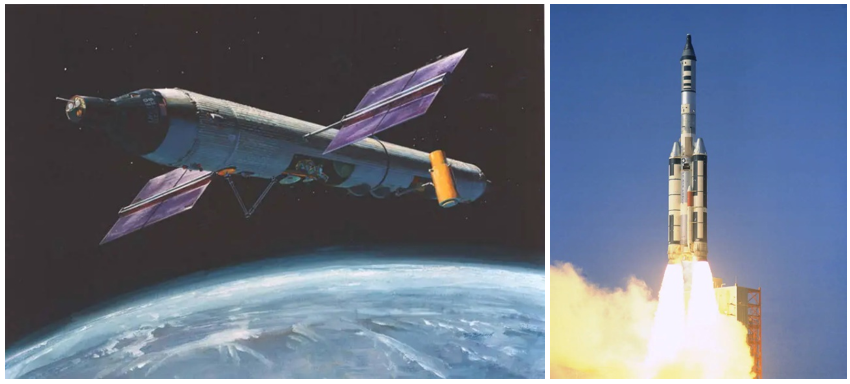
MOL in Space (left) and rocket launchIllustration of Titan-IIIC in 1966 (right)
Because MOL operated under the guise of" testing human capabilities in space, "the program publicly seemed too similar to NASA's Apollo program, so much so that Congress deemed it a duplicate and cut its funding by 60% in 1967.
By 1969, the program was far behind schedule and over budget. The 37th President of the United States, Richard Nixon, canceled the MOL program on June 10, 1969, just 4 years after it was approved. At the time of cancellation, 192 military personnel, 100 civilians and 13,187 contractors were working on the MOL program. Due to budget cuts and schedule delays, MOL's military intelligence technology has become obsolete, rendering the program's original goal virtually useless.
Although MOL was never launched into space, the project's legacy inspired future space missions. The MOL waste management system was used on board Skylab, America's first manned research laboratory in space, and technology designed for the MOL imaging system helped NASA develop Earth sensing systems.
In the 1960s, America found it difficult to gather intelligence about foreign countries. Spy planes like the Lockheed U-2 provided high-quality images, but risked being shot down and provoked foreign governments. Photo-reconnaissance satellites were protected from anti-aircraft missiles and less provocative, but they transmitted data with a delay and gave low-quality images.
To solve such problems, the Manned Orbiting Laboratory (MOL) program was launched, which aimed to expand the capabilities of US military intelligence by combining two methods: the use of a manned spy satellite in space.
The MOL program was a joint project of the United States Air Force and the National Office of Military Space Intelligence, launched after the Cuban Missile Crisis of 1962, at the height of the Cold War and the Vietnam War. President Lyndon B. Johnson approved the project in August 1965, although it was presented as an operation to study human capabilities in space.As part of the MOL program, it was planned to receive high-quality photos of foreign opponents. The operator on board the satellite could determine in real time where and when to take a picture, bypassing visibility restrictions due to clouds and data transmission delays.
MOL assumed 6 launches with a flight duration of 2 to 4 weeks. The crew would consist of 2 people who would launch on a modified Gemini capsule and return to Earth after the mission, while MOL remained in orbit.
The main payload of MOL was a telescope for military intelligence, equipped with a mirror with a diameter of 182.8 cm and codenamed Dorian.
Criticism, delays, and budget overruns
Despite the public presentation of MOL as a mission to explore human capabilities in space, its main purpose was strictly classified.
The first and only launch of the MOL program occurred on the launch pad of Cape Canaveral Air Force Base on November 3, 1966. It was a test launch test involving a Gemini capsule and a mock-up MOL without the imaging equipment on a Titan-IIIC rocket. The model went into Earth orbit and released 3 satellites. However, 30 days after launch, MOL stopped transmitting data and left orbit on January 9, 1967.
MOL in Space (left) and rocket launchIllustration of Titan-IIIC in 1966 (right)
Because MOL operated under the guise of" testing human capabilities in space, "the program publicly seemed too similar to NASA's Apollo program, so much so that Congress deemed it a duplicate and cut its funding by 60% in 1967.
By 1969, the program was far behind schedule and over budget. The 37th President of the United States, Richard Nixon, canceled the MOL program on June 10, 1969, just 4 years after it was approved. At the time of cancellation, 192 military personnel, 100 civilians and 13,187 contractors were working on the MOL program. Due to budget cuts and schedule delays, MOL's military intelligence technology has become obsolete, rendering the program's original goal virtually useless.
Although MOL was never launched into space, the project's legacy inspired future space missions. The MOL waste management system was used on board Skylab, America's first manned research laboratory in space, and technology designed for the MOL imaging system helped NASA develop Earth sensing systems.
