


Brother
Professional
- Messages
- 2,590
- Reaction score
- 533
- Points
- 113
In recent years, scientists have learned how to quickly and inexpensively sequence the human genome, curb the AIDS epidemic and come close to creating a vaccine against HIV, synthesized several promising drugs for cancer and developed a methodology for precision therapy of oncological diseases. And only one stronghold remains unapproachable - we still do not know what really causes schizophrenia and how to effectively treat it.
Scary cats
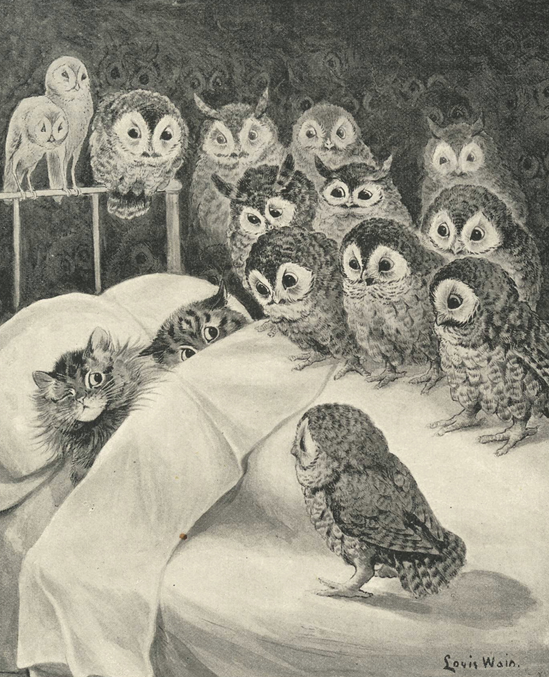
Louis Wayne was very fond of drawing cats. He graduated from the West London School of Art and from the age of 20 - after the death of his father - he was forced to make a living by painting for himself, his mother and five sisters.At 23, Wayne married 33-year-old governess Emily Richardson, but the marriage did not last long. Emily was diagnosed with breast cancer, and in order to somehow cheer up her husband, Louis gave her a little kitten. Cute and funny, he inspired the artist to create a series of paintings. Emily soon died, and the "cat" theme forever remained central to Wayne's work.
The artist's skill grew. The cats turned out to be more and more anthropomorphic. The pictures played out witty satirical plots. They were quickly sold out, and Wayne himself was invited to illustrate children's books, magazines and newspapers. Later he was even elected president of the English National Feline Club.
The people around him considered Wayne a very eccentric person, the younger sister of Louis was placed in an insane asylum at the age of 30, but he himself, until the age of 57, completely adapted to the surrounding social life ... Until suddenly the cats in his paintings began to change. From cheerful and good-natured, they turned into sad or angry. Abstract, incomprehensible patterns appeared in the background. Quirky flowers were often painted instead of cats' eyes.
Wayne's behavior has also changed. At night, he left home and wandered aimlessly through the streets. And in the house he preferred to sit alone in his room, endlessly rearranging furniture there and writing meaningless texts. Louis grew more and more, albeit groundlessly, suspected that his sisters were stealing money from him.
At the age of 64, his obsession reached its climax - the artist attacked his sister and pushed her down the stairs, after which he was hospitalized in the Springfield mental hospital. Well, the cats in Wayne's paintings finally transformed into silhouettes made up of abstract ornaments, little resembling any living creatures at all. The madness grew steadily until Wayne's death, at the age of 78.
Modern psychiatrists believe that Louis Wayne's case is a typical example of schizophrenia. The artist showed both positive symptoms of the disease: impaired perception and thinking, hallucinations, delirium, and negative: autism and social isolation.
However, usually schizophrenia manifests itself quite early, doctors associate such a late age of psychosis manifestations with the effect on Wayne's brain of the feline Toxoplasma parasite (Toxoplasma gondii ). The theory that this protist provokes schizophrenia has existed since 1953, but has not yet received full confirmation or refutation.
Louis Wayne is not the only victim of schizophrenia. Every year, a similar diagnosis is made to two patients for every 10 thousand people around the world. Epidemiologists estimate that 0.3 to 1 percent of the world's population suffers from this psychiatric disorder.
The World Health Organization lists schizophrenia as one of the 10 most severe diseases in economics. But surprisingly, even before 1908, scientists were not sure that such a disease even existed. And what is its real mechanism, no one understands even now.
For a long time, drugs against schizophrenia worked to a greater extent against the so-called positive, or productive, symptoms of the disease, helping to relieve delusions, hallucinations and other disturbances of consciousness. With negative symptoms, for example, with psychophysical indifference, anhedonia and cognitive impairment, in most cases the patient could be left alone.
In 2015, a drug was registered in America that can reduce the severity of both positive and negative symptoms. In 2019, such a drug was registered in Russia and has been available to Russian patients since August.
Psychiatrist on the Orient Express
The most important concept of nineteenth-century psychiatry is dementia, or "dementia." In that era, any deviation could be brought under it - from a general decline in intelligence to inconsistency and oddities in thinking.In 1860, French psychiatrist Benedict-Augustin Morel drew attention to the mental disorder that affects young men at the time of puberty. In the early stages, the disease could have various symptoms, but with age, patients still came to a common outcome - dementia. In his diagnosis, Morel decided to start not from the current clinical picture of the disease, but from its outcome, and therefore called it Dementia praecox - early, or premature, dementia.
A decade later, German psychiatrists Ludwig Kalbaum and Ewald Hecker described in detail the dynamics of the disease they called hebephrenia (from the ancient Greek words ἥβη - "youth" and φρενός - "consciousness").
Hecker wrote: “Young patients demonstrate clear deviations from the logically correct construction of sentences, they are not able to connect them into a single whole and express their thoughts accurately. This is followed by a series of attacks of mania and melancholy. It is replaced by a phase of indifference, interrupted by short bursts of excitement or hallucinations, most often auditory. It all ends with exhaustion and death."
At the time, both physicians believed that hebephrenia was a separate disorder that had nothing to do with Dementia praecox .
Kalbaum also identified two more diseases - catatonia and paranoia. The first manifested itself in the form of spontaneous, aimless, excessive motor activity; echolalia and echopraxia - repetition of words and actions of people around. Or vice versa - in the form of prolonged stupor and torpor.
Paranoia, on the other hand, was expressed in unhealthy suspicion, fears and overvalued ideas (for example, erotomania - the irresistible confidence that some famous person is secretly in love with a sick person and sends encrypted confessions of his feelings from the stage or in print).
As a result, by the end of the 19th century, a situation arose when the number of identified symptom complexes became so great that the diagnosis turned into an art rather than an exact science. It was not clear how all of them relate to each other, there was no single coherent classification of diseases.
Emil Kraepelin brought order to the discipline. In his Textbook of Psychiatry (nine editions from 1893 to 1927), he suggested that all psychoses fall into two large groups. The first ones affect mainly the affective sphere and have a characteristic changeable course with regular exacerbations - manic-depressive disorder. And the latter affect not only emotions, but also lead to the disintegration of mental functions.
Having imposed this criterion on the previously identified symptom complexes, Kraepelin came to the conclusion that Dementia praecox , hebephrenia, catatonia and paranoia are not separate independent diseases, but just different syndromes or stages of one common disease. Kraepelin, like Poirot in the Orient Express dining car, accused all the suspects of the same crime.

Louis Wayne "The Neighbor's Cat"
Not weak, but split
From Kraepelin's point of view, Dementia praecox is caused by some unknown brain pathology. That is why this disease always has an unfavorable development prognosis - the condition of most patients only worsens over the years, and very few cases of remission are known in the history of medicine. But as soon as this pathology is detected, psychiatrists will be able to create an effective method of treatment.Another well-known psychiatrist and contemporary of Kraepelin, Eugen Bleuler, was of the opposite opinion. The first teacher of Carl-Gustav Jung and a colleague of the young Sigmund Freud, Bleuler developed the concept of Dementia praecox , suggesting that in the course of this disease, the connection between different functions of consciousness is disrupted, their separation or splitting occurs.
And if so, Bleuler decided, the term "early dementia" does not describe the specifics of the disorder and it is better to use the name "schizophrenia" (from ancient Greek σχίζω - "splitting" and φρήν - "consciousness").
Among other things, the scientist has developed a systematic model of the symptoms of schizophrenia, dividing them into "nuclear" and "secondary". To the latter he included all the classic symptoms of Dementia praecox , such as hallucinations and delusions. From Bleuler's point of view, this is just the patient's reaction to the disease, and it is based on the well-known 5A (sometimes 4A or 6A) psychiatry textbooks: autism, apathy, abulia, ambivalence, associative thinking and abnormal affectivity (most of them could be observed in Louis Wayne's behavior).
Based on this model, Bleuler identified the main forms of schizophrenia: hebephrenic, catatonic, paranoid, latent and simple.
So in 1908, the medicalization of insanity and the construction of this disease was completed, but the question of its causes was still open. What is primary: a certain life experience, a traumatic event that causes a mental disorder and, after it, a pathological change in the brain, or, conversely, a pathology in the nervous system leads to a splitting of the psyche, and the disease itself, as Morel assumed from the very beginning, has a hereditary and degenerative character?
In that era, it was impossible to answer this question. The development of genetics and neurophysiology does not help to answer it even now.
Schizophrenia as an atavism
What we today consider to be something strange and pathological: visions, voices, unusual behavior that does not correspond to the situation, and so on, in ancient times would rather be considered manifestations of the divine presence. American psychologist and historian of psychology Julian Janes generally suggested that human consciousness, as we know it now, did not emerge until the end of the Bronze Age (around the 12th century BC).After analyzing many texts like the Iliad and Odyssey by Homer, the Old Testament and others, Jaynes noticed that the heroes of myths in a difficult situation never make independent decisions - at such a moment a vision of some deity appears to them or a voice is heard announcing how to proceed. Now this would be called a visual or auditory hallucination.
According to Jaynes, this is due to the fact that the consciousness of our ancestors was bicameral - mental functions were divided between two hemispheres, so the decision made was not perceived as something related to the inner reality of a person, but was taken outward, in the form of a "commanding voice" or visible image. Human consciousness of the modern type arose when people stopped considering voices as something external, and realized that they sound only in their heads and belong to them.
Jaynes' ideas influenced science fiction writers more than scientists. In the famous TV series "Westworld", more than one episode is devoted to the bicameral consciousness, but the main character - the gynoid Dolores - a voice constantly whispers: "Remember, remember."
Now this "commanding voice" is considered one of the most common symptoms of schizophrenia, and Janes himself believed that schizophrenia was just a malfunction, returning the human brain to work in an archaic preconscious state.
In general, this is a convenient theory, and the only problem is that it cannot be falsified, which means that it does not fall under the conventional criteria of scientific character. But most importantly, it does not suggest any methods of treatment or social adaptation for patients.
Stress response
Back in 1939, the Norwegian psychiatrist Gabriel Langfeldt discovered that, in addition to the inexorably progressive form of schizophrenia, there are cases when previously perfectly healthy people suddenly show a wide range of psychotic symptoms. Most often this happened after a lot of stress. Langfeldt called this type of reaction "schizophrenic psychoses."Experiments with this group of patients have shown that they respond well to treatments such as insulin shock and corazole convulsive therapy, while they do not work in "normal" patients with schizophrenia. Soon, the diagnosis of "schizophrenic psychoses" gained great popularity among psychiatrists, as it made it possible to single out a subpopulation of patients who respond to treatment and are even capable of complete remission.
However, Langfeldt's discovery rather confirmed the correctness of Bleuler, who argued that a number of symptoms are secondary and, most likely, nonspecific (the same hallucinations and delusions occur with intoxication and even just a high temperature), which means that more attention should be paid to nuclear symptoms and the reasons for their occurrence.
It's about the brain
The Kraepelin hypothesis of brain pathology has attracted psychiatrists the most from the very beginning. The logic here is obvious: a violation in an organ causes painful changes in its function. Everything is clear and simple. However, there were no adequate methods for proving it for a long time. In 1972, neurologist Fred Plum joked that schizophrenia is a "graveyard for neuropathologists."The first theories on this subject concerned the observed morphological changes in the brain. In patients with schizophrenia, during postmortem visual examination, the cerebral ventricles (four natural cavities inside the brain, which are normally filled with cerebrospinal fluid) were significantly enlarged, which indicated a decrease in the proportion of gray matter. These observations were subsequently repeatedly confirmed by the method of computed and magnetic resonance imaging.
By the end of the 20th century, it was firmly established that in patients with a diagnosis of schizophrenia, the frontal lobes are on average always smaller than in healthy people. It would seem that these facts prove that schizophrenia is a consequence of the pathological development of the brain or its degeneration throughout life. However, what caused it? And isn't the intense death of neurons the result of mental illness, and not its cause?
A competing theory has focused on altering metabolism in specific areas of the brain. In 1974, two Swedish neurophysiologists discovered an interesting fact: the frontal lobes of patients with schizophrenia are supplied with less blood than in completely healthy subjects. Moreover, this pattern increases with age. In other words, decreased metabolism was observed in the prefrontal cortex of mentally ill people.
Daniel Weinberger, a leading specialist in the human frontal lobes, developed this hypothesis. He found that in experiments with the Wisconsin neuropsychological card sorting test, subjects in the control group significantly increased blood flow in the dorsolateral prefrontal cortex. This is natural, since the test is aimed at assessing the flexibility of thinking and the ability to quickly switch between different tasks, and it is for these abilities that this region of the brain is responsible.
At the same time, no significant changes in blood flow in the dorsolateral prefrontal cortex were observed in schizophrenic patients. Consequently, the root of the problem had to be sought in the activity of neurons in the frontal lobes.
In parallel to Weinberger's experiments, British psychiatrist Timothy Crowe, who later became famous for the speculative and unproven theory of schizophrenia as the payment of humanity for language proficiency, suggested that there are actually two types of schizophrenic syndromes. And it is possible that these are actually two mental illnesses that are different in their etiology.
For the first type, Crow believed, positive symptoms (hallucinations, delusions, thinking disorders) are characteristic, and it is associated with the activity of the neurotransmitter dopamine in the mesolimbic pathway. And for the second type - negative symptoms (flattening of affect, loss of will and apathy, impoverishment of speech), which is the result of the functioning of dopamine in the mesocortical tract.
Dopaminergic neurons of the mesolimbic and mesocortical pathways regulate motivational processes, the feeling of pleasure (and anhedonia - the inability to experience pleasure - is another characteristic symptom of schizophrenia), the motivational significance of certain objects (remember erotomania, delusions of jealousy or greatness - when another person or personality becomes overvalued patient), the formation of the structure and plans of behavior, its adequacy to the situation.
In addition, dopaminergic neurons are located in the striatum, a striatum that plays a key role in the regulation of muscle tone and motor activity in humans. An increased level of dopamine here can cause catatonic attacks.
So, by the beginning of the 21st century, neurophysiologists had three competing groups of theories about pathological changes associated with schizophrenia. The first group relied on structural changes in the brain - the degradation of the gray matter. The second noted changes in the activity of neurons in the dorsolateral prefrontal cortex. The third pointed to the critical role of neurotransmitters, primarily dopamine and sometimes glutamate.
The case of dendritic spines
The presence of three different pathologies underlying one disease indicates either that these are different diseases with similar symptoms, or that they have a single, but not yet disclosed mechanism. And research in recent years has shown that, probably, all neurophysiological theories can be brought to a common denominator.The neurons on the membrane have special outgrowths - dendritic spines. With their help, nerve cells form synaptic connections and combine into single neural ensembles necessary for information processing, the implementation of mental functions and behavior.
The Arp2 / 3 protein complex plays an important role in the formation of dendritic spines. It was isolated only in 1989, and described in 1994. Arp2 / 3 is responsible for the creation of the cell skeleton, without which the appearance of dendritic spines is impossible.
In 2015-2017, it turned out that in model organisms - mice with "schizophrenia" - the number of dendritic spines in the neurons of the dorsolateral prefrontal cortex is less than in ordinary rodents. A decrease in their number can lead to a reduction in the connections of neurons in the frontal lobes, a decrease in the need for nutrients, a decrease in blood flow and, as a result, provoke apoptosis (death) of "extra" nerve cells in this area.
Even more interesting, the dorsolateral prefrontal cortex is associated with the striatum and can modulate dopamine production in it. Therefore, according to the feedback mechanism, a decrease in the activity of neurons in the dorsolateral prefrontal cortex leads to hyperdopaminergy in the striatum - a sharp increase in dopamine production. So, within the framework of one theory, it was possible to link all the known brain pathologies associated with schizophrenia.
Congenital or acquired?
Clarification of the neurophysiological background of schizophrenia, however, does not answer the question: what exactly causes disease-causing changes in the brain? There may be several answers.The first and most obvious one is genetic predisposition. However, unlike many other, including psychiatric, diseases for schizophrenia, no persistent genetic markers characteristic of most patients have yet been found. This led to the recognition of schizophrenia as a polygenomic disease in 2002.
Over the next decade and a half, a number of works in the field of genome-wide association studies have discovered more than a hundred single-nucleotide polymorphisms (single-nucleotide polymorphism) associated with symptoms of schizophrenia, almost evenly distributed throughout the genome.
Another answer may be associated with prenatal and postnatal factors - the age of the parents, the characteristics of the course of pregnancy and childbirth. The most consistently traced relationship with the age of parents, especially fathers. The higher it is, the more likely a child will develop childhood autism or symptoms of schizophrenia during adolescence.
The risk of disease in the offspring of fathers over 50 compared to dads at the age of 20-25 varies between values of 1.46 and 3.37 times. It is believed that the blame for everything is the accumulation of genetic mutations in male gametes over the years, as well as the transfer of aberrant patterns of DNA methylation - an epigenetic mechanism for regulating the activation of certain genes - from the father to the fetus ...
There are other factors with less pronounced or insufficiently proven influence: maternal stress, infections during pregnancy, as well as a lack of iron, folic acid and especially vitamin D in the mother's body during gestation and in the newborn itself in the first months of life (especially if it was born in winter or early spring), hypoxia (oxygen starvation) of the fetus.
Finally, schizophrenia can be caused, as may have been the case with Louis Wayne, the feline parasite of Toxoplasma. Toxoplasma is known to change the behavior of mice, causing them to behave more risky and reckless. This helps cats to catch them, eat them and continue the life cycle of this parasite. However, it also affects the psyche of people, and acute Toxoplasma infection sometimes leads to psychotic symptoms that do not differ from schizophrenia.
At the same time, haloperidol - one of the most popular drugs for the treatment of psychosis - stops the development of toxoplasma in cell cultures. A recent study found that Toxoplasma is likely responsible for 21.4 percent of diagnoses of schizophrenia.
The most radical, but at the same time the most advanced was the neuroimmune theory of schizophrenia. The relationship between the nervous and immune systems is now one of the hottest topics in biomedical research. A year ago, biologists from Harvard Medical School discovered that Staphylococcus aureus (Staphylococcus aureus) has learned to control the activity of sensory neurons in the lungs, "forcing" them to suppress the immune response in this organ.
And this is far from the only example of the amazing connection between the central nervous system and immunity. The real sensation was the remission of psychosis in a 24-year-old "Japanese patient" diagnosed with paranoid schizophrenia after a bone marrow transplant from a mentally healthy donor as part of cancer therapy.
At the end of the operation, the young man had significantly reduced psychotic symptoms and improved social adaptation. Follow-up evaluation two and four years after the transplant confirmed that the remission was stable. This and several other cases have reawakened the discussion about schizophrenia as a consequence of a malfunction in the immune system of the human body and about bone marrow transplantation as a variant of cell therapy that counteracts inflammatory reactions.
A century with schizophrenia
More than 110 years have passed since the "official" appearance of the disease, its symptoms and syndromes are well described and studied, but the true causes of schizophrenia still remain hidden, as at the beginning of the 20th century. On the sidelines of scientific progress, many concepts have remained: psychological, about the "schizophrenogenic mother" and contradictory, incompatible demands (double bind) in "schizophrenogenic families."The theory of bicameral consciousness still holds, but only because it cannot in principle be refuted. Hopes for genetics were never realized, and neurophysiology, instead of answers, rather simply helps to formulate the question more accurately.
Schizophrenia remains an unconquered height to this day, challenging a new generation of doctors and biologists. And the most important of them is to achieve stable remission in patients, especially those with severe forms of catatonic schizophrenia, to find truly effective drugs and methods of treatment.
Others think that this is not worth doing, because “A lofty mind is a neighbor to madness. Solid border between them is not". Perhaps, without schizophrenia, we would not have had game theory in mathematics (John Nash), science fiction novels by Philip Dick, Scriabin's color music, paintings by Louis Wayne and other heights of the human spirit.
But are these breakthroughs of units of torment worth hundreds of thousands?

