

Carding
Professional
- Messages
- 2,870
- Reaction score
- 2,522
- Points
- 113
The use of cheats is no exception for Rockstar.
Recently, it became known that Rockstar Games, known for its tough stance against piracy and cheating, uses pirate cracks to remove DRM (unauthorized copy protection systems) from some of its games sold on Steam. According to BleepingComputer and blogger Vadim M., Rockstar Games uses quacks from the Razor 1911 group to circumvent its own anti-piracy measures.

 www.youtube.com
Rockstar Games and its parent company, Take Two, have always been strongly opposed to cheat developers and those involved in reverse engineering games. Therefore, the news that the company itself uses pirate quacks caused a lot of surprise in the gaming community.
It all started with a video by Vadim M., in which he talked about how Rockstar Games used crack for the games Manhunt and Max Payne 2 on Steam. This interested a modder and reverse engineer named Silent, who decided to check if the same technique was used for other games, such as Midnight Club II, which is no longer sold on Steam. It turned out that the game comes with an executable file "testapp.exe", which also uses the quack from Razor 1911.
Compatibility Issues
Silent explained that the use of quacks led to known problems with running Manhunt and Midnight Club II on Windows Vista and later operating systems. The reason lies in the fact that Steam DRM included a section of code that was not marked as code, which triggered the Data Execution Prevention (DEP) system.
In response to the news, Razor 1911 posted the following tweet:
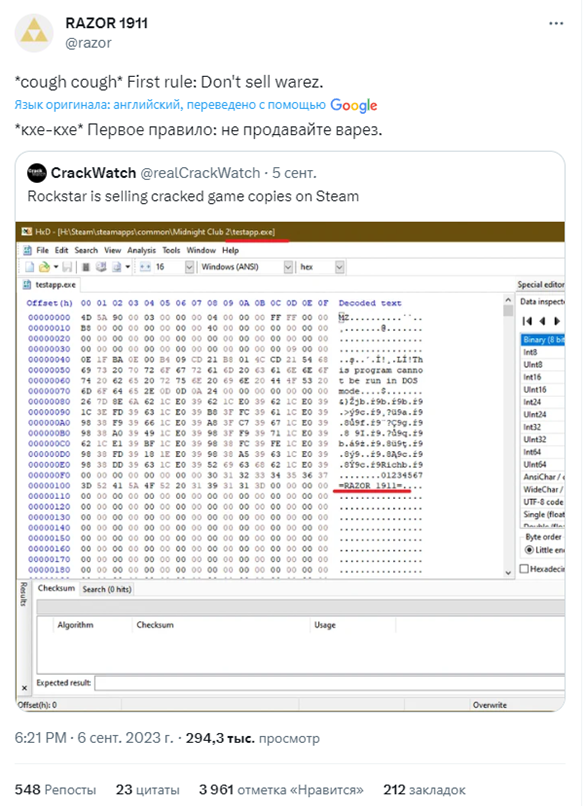
The Razor 1911 Tweet
At the moment, Rockstar Games has not commented on the situation. This case calls into question ethical norms and practices in the video game industry, especially considering that Rockstar Games has always been a strong advocate of anti-piracy measures. Whether we should expect a change in the company's position or whether it will remain just a curious incident is still unclear.
Recently, it became known that Rockstar Games, known for its tough stance against piracy and cheating, uses pirate cracks to remove DRM (unauthorized copy protection systems) from some of its games sold on Steam. According to BleepingComputer and blogger Vadim M., Rockstar Games uses quacks from the Razor 1911 group to circumvent its own anti-piracy measures.
Manhunt - Hidden Anti-Piracy Measures - Feat. BadgerGoodger
In this video, we’ll be looking at the anti-piracy measures in Manhunt, ones left by Rockstar to protect their game from pirates.But this is a very special c...
www.youtube.com
Rockstar Games and its parent company, Take Two, have always been strongly opposed to cheat developers and those involved in reverse engineering games. Therefore, the news that the company itself uses pirate quacks caused a lot of surprise in the gaming community.
It all started with a video by Vadim M., in which he talked about how Rockstar Games used crack for the games Manhunt and Max Payne 2 on Steam. This interested a modder and reverse engineer named Silent, who decided to check if the same technique was used for other games, such as Midnight Club II, which is no longer sold on Steam. It turned out that the game comes with an executable file "testapp.exe", which also uses the quack from Razor 1911.
Compatibility Issues
Silent explained that the use of quacks led to known problems with running Manhunt and Midnight Club II on Windows Vista and later operating systems. The reason lies in the fact that Steam DRM included a section of code that was not marked as code, which triggered the Data Execution Prevention (DEP) system.
In response to the news, Razor 1911 posted the following tweet:
The Razor 1911 Tweet
At the moment, Rockstar Games has not commented on the situation. This case calls into question ethical norms and practices in the video game industry, especially considering that Rockstar Games has always been a strong advocate of anti-piracy measures. Whether we should expect a change in the company's position or whether it will remain just a curious incident is still unclear.

