


Brother
Professional
- Messages
- 2,590
- Reaction score
- 533
- Points
- 113
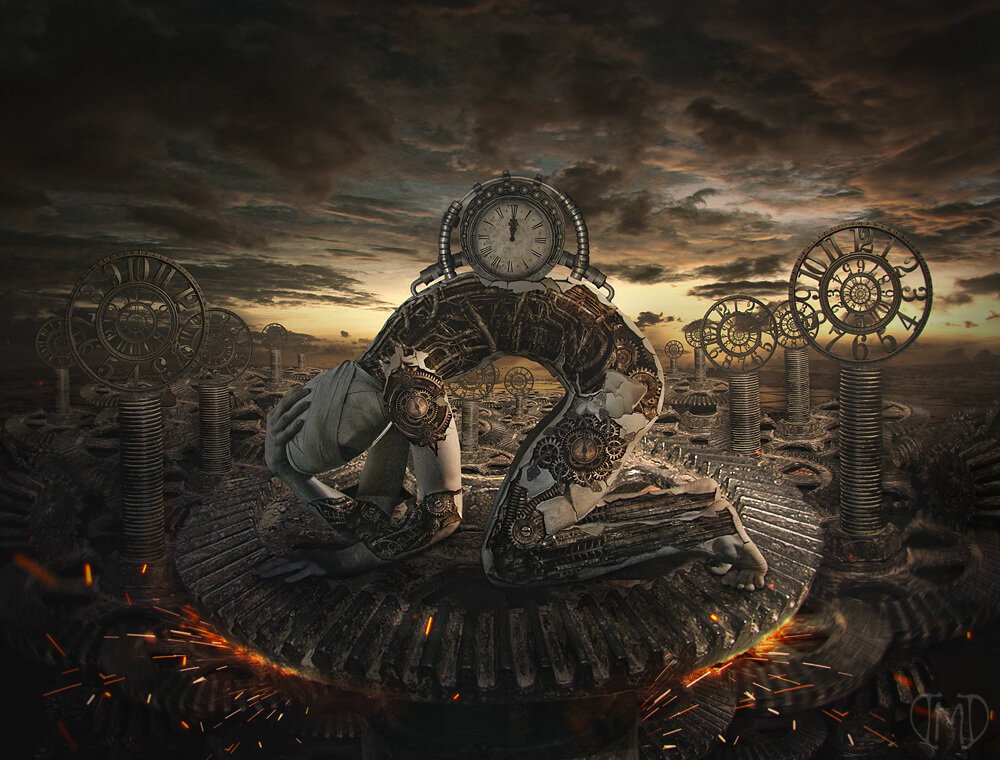
Reflecting on Albrecht Altdorfer's painting Alexanderschlacht or Alexander's Battle at Issus (1529), the German historian Reinhart Koselleck wrote that in medieval Europe time was marked with “expectations” and therefore the painting was full of signs. When German poet and critic Friedrich Schlegel (1772-1829) came across Alexanderschlacht in the Louvre almost three centuries after its creation, he was blinded by “seeing this miracle,” but for him the painting had no deeper meaning - it was just a work of art from a specific historical era. As Koselleck argued, in three hundred years the very idea of "time" has undergone a transformation.Throughout its history, mankind has accumulated a huge number of different rules for calculating and interpreting what time means. These interpretations were flexible, as they depended on different things, and over the centuries have undergone changes. How does our perception of time differ from the perception of time by a person of the Middle Ages or the Age of Enlightenment? What determines our attitude to this category? What has the democratization of time and the general availability of monitoring it led to? And why does the idea of the end of the world no longer excite humanity as it did a thousand years ago?
When Altdorfer drew the battle scene, the hustle and bustle of everyday life was mingled with fear of the inevitable end of the world ( eschaton , as it is called in the ancient Greek translation of the Hebrew Bible). The rise of the Ottoman Empire, in particular, was a direct cause of concern, and the Antichrist, in a more theological sense, caused widespread alarm. At the beginning of the 19th century, the time for Europeans no longer foreshadowed the inevitable end of the world. Rather, it began a thousand li journey from Isaac Newton's "absolute, true and mathematical time" to the modern cesium clock.
“Time” became linear, and after the French Revolution of 1789, the future sounded like the promise of utopia. To speed things up, post-revolutionary France seriously declared that 1792 would be the first year of the new calendar. The months were divided into three "decades", each lasting ten days, and the days were divided into 10 hours and each hour into one hundred decimal minutes, and so on. Then in 1929, the USSR under Stalin canceled the seven-day week and replaced it with a five-day one, and the days were called yellow, pink, red, purple and green. And in 2002, the President of Turkmenistan announced that January will henceforth be called "Turkmenbashi", as well as his official title "Head of the Turkmen". Time and again our clocks and calendars become hostages of the ideological needs of the state.
More importantly, as noted by the German historian Jürgen Osterhammel in his book Transformation of the World. A Global History of the Nineteenth Century ”(2009), the democratization of time - thanks to clocks in city squares and later to the availability of wristwatches - changed the way North Atlantic regions in the 19th century understood their relationship to this spread of homogeneous time ... But this also created problems. So in Germany, where there were five time standards, it took a bold campaign of the Prussian Field Marshal Helmut von Moltke the Elder to convince parliament to establish a uniform time from the Greenwich meridian. As historian Vanessa Ogle writes in her book The Global Transformation of Time (2015):
Outside of Europe, much of the world followed different rules and interpretations of what time meant. In India, various Hindu almanacs proposed extremely complex divisions of time, one within the other - from the microseconds used for rituals to the great cosmological eras to describe the universe and space itself. For the Lakota Indians in America, time included hours that responded to the movement of the moon; October was for them "Leaves Falling Month", as author Jay Griffiths writes in his book Tick tock. A look at time from the outside ”(1999). In Burundi, those dark, impenetrable nights, when faces are no longer recognizable, were called "Who are you?" nights. In the Islamic world, the first prayer of the day was to be read when "the white thread (light) of dawn can be distinguished from the black thread (darkness of the night).""Overcoming the regionalism inherent in adhering to five different local times was as much a matter of national security as it was of nation building."
The "cow dust hour" still exists in Rajasthan. This expression is used to describe the melancholy of the evenings, when the cows, at the end of the day, return from the pastures, raising clouds of dust; Michael Ondaatje describes this in a poem:
“This is the hour that we move little by little
in the last possibilities of light. "
For traditional Japanese, the year was divided into 72 microseasons called "ko", each of which lasted five days (for example, the days from March 16 to 20 are when "caterpillars become butterflies"). These time scales are long enough to remember, but short enough to remind us of how fleeting the present is. Time was born from intuitions, the rhythms of nature, religious precepts and the needs of agriculture.
By the middle of the 19th century, the railway revolution, which connected the distant parts of Europe and the United States, made it clear that all cities and towns adhered to their own time. The larger the territory of the country, the greater the mismatch. In North America alone, there were at least 75 time standards. In 1884, in Washington, DC, thanks to the efforts of the Scottish-Canadian engineer Sandford Fleming, the International Meridian Conference took place, which tried to rationalize time - for the whole world. From now on, a single "world time" with 24 time zones was to appear. The political resistance within the countries against the introduction of any changes even in the mechanical aspects of time measurement was impressive.
In the colonial world, efforts to standardize the times were inseparable from anti-colonial sentiments and the challenges of uniting new nationalisms. On December 1, 1881, the British governor of Bombay, James Fergusson, informed the city that from that day on "all institutions under the control of the government use Madras time, which is considered the official time for all purposes." Madras time, which was used in the southern coastal city of Madras, was 40 minutes ahead of local time in Bombay. There was a fierce discussion in the newspapers about where to use this or that time. The Bombay Chamber of Commerce campaigned for a referendum on whether the clock on the university tower should show Madras or Bombay time. As might be expected, the people of Bombay voted to show Bombay time, and the Fergusson administration, In an effort to demonstrate to the natives the consequences of neglecting orders, she stopped funding clock lighting at night due to the criminal display of "unofficial time." It took nearly 44 years after the establishment of Indian Standard Time in 1906, Ogle recalls, until the Bombay Municipal Corporation finally abandoned Bombay time and thus ended the little-known battle of the clocks.
Since the middle of the 20th century, the standardization of time has become an important component of the postcolonial nation-building. For example, North Korea has repeatedly moved the clock to half an hour over the past decade to reflect reconciliation or tensions with its southern kinsmen. On the contrary, India, which stretches from west to east for almost 3,000 kilometers, which means that the distant parts of the country watch the sunrise with a difference of almost two hours, stubbornly refuses to set more than one time zone. In a recent study“Bad dream. Sunset time and the production of human capital (2018) economist Mavlik Janyani argued that delaying average sunset time by one hour reduces children's education by 0.8 years due to lack of sleep and early start of school. He calculated that, thanks to the transition from one to two time zones, the increase in human capital could be approximately US $ 4.2 billion.
Against the background of all these transformations of time, mediated by reason, history and the state, the human experience of our time continues to testify to the impossibility of simple categorization. As the Greek philosopher Heraclitus reminds us: "You cannot enter the same river twice."... More than a thousand years later, Saint Augustine reflected on time in a more personal, even confessional manner: he knew what time was, but when he tried to describe it, he could not. Another millennium passed, and the French philosopher Michel Serre wrote that "time does not flow, it leaks." According to Serre, time was no longer a free flowing stream, but rather a coagulant that partially passes through the sieve of the human mind as a witness to our shaky self-proclaims that this is a unique moment, as well as the reason for our innermost fear that we are doomed to relive the present again and again.
The constant gaze of algorithms run by governments, corporations, and the technology that document all of our actions seems to be betting on this concept of eternal recurrence - given enough time to observe, their learning algorithms will fully understand us. Time becomes the fire in which the steel of observation is tempered. Among all these great, powerful forces fighting for the ability to control and influence us, we live our lives as if we are immortal. The episodic quest for freedom that we begin to find the elusive self remains our only way to witness our presence on this earth. Everything else, as we know somewhere deep inside, is ultimately subject to time.

"The Battle of Alexander at Issus" / Wikimedia Commons

