A Complete Methodology for Preparing, Introducing, Reviewing, and Passing Bills in the US Congress

Good Carder

Professional
Messages
471
Reaction score
353
Points
63
The US legislative process is governed by the Constitution (primarily Article I), House and Senate rules, and precedents. It is complex, non-linear in practice, and most bills (over 90%) die in committee. The following provides a complete, step-by-step methodology, drawing from official sources like the House Office of the Legislative Counsel (HOLC) Guide to Legislative Drafting, How Our Laws Are Made (Congress.gov), Congressional Research Service (CRS) reports, and Congressional Budget Office (CBO) procedures.

1. Preparation (Idea to Draft)​

  • Sources of Ideas: Constituents, lobbyists, executive branch (e.g., President's budget message), state legislatures (memorials), think tanks, or Members' own priorities. Ideas often stem from identified problems needing federal solutions (e.g., interstate commerce clause authority).
  • Drafting Process:
    • A Member (or staff) consults the House or Senate Office of the Legislative Counsel for professional drafting to ensure clarity, constitutionality, and consistency with existing law.
    • Decide form: Bill (most common; becomes "An Act" after one-house passage) or joint resolution (for some matters like continuing appropriations or constitutional amendments). Avoid concurrent/simple resolutions unless non-binding.
    • Key Conventions(HOLC style):
      • Use "shall" for mandatory duties; "may" for permissive.
      • Singular preferred for clarity.
      • "Means" = exclusive definition; "includes" = non-exclusive.
      • Amend existing law via precise instructions (outside quotes) + quoted new text (inside quotes).
  • Detailed Structure of the Document Package (Bill Text): Bills follow a standardized format (HOLC template). A complete introduced bill package is primarily the bill text (printed by Government Publishing Office), plus sponsor's introduction statement in the Congressional Record. No formal "fiscal note" is required at introduction, but major bills often include informal justifications.
    Full Structure (Freestanding Bill Example):
    • Long Title (Caption): "A BILL [or An Act] To [describe purpose in one sentence]."
    • Enacting Clause (required): "Be it enacted by the Senate and House of Representatives of the United States of America in Congress assembled,"
    • Section 1: Short title (e.g., "This Act may be cited as the '[Short Title] Act of [Year].'").
    • Findings/Purposes/Preambles (optional; use sparingly to avoid ambiguity): "Whereas..." or policy declarations.
    • Definitions (often early or in a dedicated section): Precise, using "means" or "includes."
    • Operative Provisions(core body; organized per general template):
      • Main rule/general authority.
      • Exceptions.
      • Special rules (different treatment).
      • Transitional rules.
      • Other provisions (e.g., enforcement, penalties, reporting requirements).
      • Authorization of appropriations (if needed; avoid vague "such sums as may be necessary").
      • Effective date (defaults to enactment unless specified; apply to "amendments made by this Act").
    • Higher-Level Organization (for complex/omnibus bills): Division → Title → Subtitle → Chapter → Part → Subpart → Section → (a) subsection → (1) paragraph → (A) subparagraph → (i) clause → (I) subclause.
    • Technical Elements: Table of contents (if long); savings clauses; severability; conforming amendments.
    • Amending Existing Law: Use "strike" / "insert" or full quotes for precision (Ramseyer/Cordon rules later require showing changes in reports).
  • Legal/Technical Documentation at This Stage: Draft bill text only. Executive communications (if used) may attach proposed language.

2. Introduction​

  • House: Sponsor drops bill in the "hopper" (rostrum box) during session. Assigned H.R. number; referred by Speaker/Parliamentarian to committee(s) with jurisdiction (possible multiple referrals).
  • Senate: Presented to clerk or on floor; assigned S. number; referred by Parliamentarian.
  • Cosponsors: Added post-introduction (unlimited in House until committee action).
  • Document Package: Printed bill + Congressional Record entry (sponsor's remarks). Bill is public immediately via Congress.gov.

3. Committee Review (Most Bills Die Here)​

  • Referral: To standing committee(s) (e.g., Ways & Means for tax).
  • Hearings: Public (announced 1 week ahead); witnesses testify; transcripts printed.
  • Markup: Amendments voted on; "clean bill" possible.
  • Reporting: Committee votes to report favorably (with/without amendments). Quorum required; no proxy voting in House.
  • Key Documentation(expands the package):
    • Committee Report (e.g., H. Rept. 119-XXX): Purpose; section-by-section analysis; changes in existing law (Ramseyer/Cordon); CBO cost estimate; constitutional authority statement; unfunded mandates statement; vote tally; minority/supplemental views; earmark list (or "none").
    • Hearings record.
    • Agency views/GAO reports (requested).

Bills not reported are effectively dead unless discharged (rare).

4. Expanded Financial and Economic Justification Algorithm (CBO Scoring)​

Bills with budgetary impact require CBO cost estimates upon full committee approval (Congressional Budget Act of 1974). This is the formal "financial/economic justification" — advisory but critical for rules, debate, and scoring against budget resolutions.

CBO Process (Step-by-Step Algorithm):
  1. Receive Bill Language: CBO analyzes exact text post-committee markup.
  2. Establish Baseline: Compare to current law projections (CBO baseline: 10-year window for spending/revenues; incorporates economic assumptions).
  3. Provision-by-Provision Analysis:
    • Identify direct spending, revenues, or discretionary effects.
    • Use data/models from agencies, historical trends, economic literature.
    • Incorporate behavioral responses (e.g., how people/firms react).
    • Estimate intergovernmental/private-sector mandates (Unfunded Mandates Reform Act).
  4. Quantify Uncertainty: Explicitly note ranges, assumptions, and limitations in "basis of estimate."
  5. Dynamic Scoring (for major bills): Optional but used for large tax/spending proposals; includes macroeconomic feedback (e.g., GDP growth effects).
  6. Output: Formal letter/report with tables (outlays, revenues, deficit impact) + narrative. Includes 5- and 10-year totals.

Expanded Justification Elements (often in committee reports or sponsor materials):
  • Cost-benefit analysis (informal).
  • Regulatory impact (if applicable).
  • Economic modeling (e.g., JCT for tax bills).

CBO estimates are non-partisan and publicly available on CBO.gov.

5. Floor Action​

  • House: Rules Committee issues special rule (debate limits, amendments). Committee of the Whole for amendments; then full House vote (simple majority). Electronic voting.
  • Senate: Motion to proceed; unlimited debate (filibuster possible; cloture at 60 votes). Unanimous consent agreements common. Simple majority passage.
  • Documentation: Congressional Record (debate, amendments, votes).

6. Other Chamber + Reconciliation​

  • Bill goes to second chamber (mirrors process).
  • If versions differ: Concurrence or conference committee (conferees negotiate; produces conference report + joint explanatory statement). Both chambers vote up-or-down on report.
  • Documentation: Engrossed/enrolled bill; conference report (with earmarks).

7. Presidential Action + Enrollment​

  • Enrolled bill (parchment copy) presented to President.
  • Options: Sign → Public Law (e.g., P.L. 119-XXX); veto (override by 2/3 both houses); pocket veto (if Congress adjourns); or becomes law after 10 days (if in session).
  • Final Documentation: Slip law → Statutes at Large → U.S. Code (codified).

Complete Legislative Process Flowchart (visualized above; standard path shown in second image): Idea → Introduction → Committee (hearings/markup/report) → Floor (debate/vote) → Other Chamber → Conference (if needed) → Enrollment → President → Law (or veto/override).

Real-World Examples​

  • Affordable Care Act (ACA, P.L. 111-148, 2010): Introduced as H.R. 3590 (Senate vehicle). Extensive committee hearings/markups in both chambers. House passed its version; Senate used reconciliation (51-vote threshold) to finalize after Scott Brown election. CBO scored extensively (deficit reduction claimed). Conference avoided via reconciliation. Signed by President Obama after year-long process. Demonstrates committee work, floor amendments, and budget tools.
  • Recent Simpler Example: Many infrastructure or appropriations bills follow the full path but use omnibus packaging and unanimous consent for speed.

Tips for Success: Build coalitions early; secure committee chair support; use budget reconciliation for partisan priorities (bypasses filibuster); anticipate CBO score impacts on rules. Track via Congress.gov (bill status, texts, reports).

This methodology is comprehensive but flexible — actual paths vary by politics, urgency, and procedure (e.g., suspension of rules). For drafting templates, see HOLC resources; for live tracking, use Congress.gov.

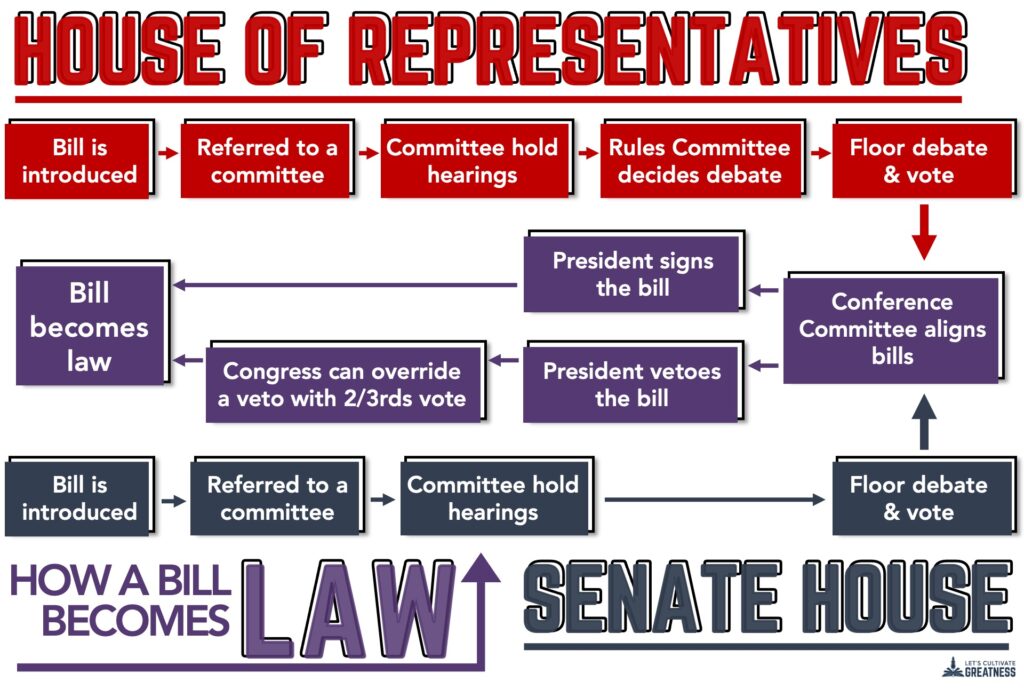
legislative-process-poster.jpg


1-How-A-Bill-Becomes-Law-Flowchart-1024x697.jpg
 

Budget Reconciliation: A Detailed Explanation of the Special Fast-Track Legislative Process​

Budget reconciliation is a powerful, expedited procedure under the Congressional Budget Act of 1974 (as amended) that allows Congress to pass certain fiscal legislation — specifically changes to revenues (taxes), direct (mandatory) spending, or the federal debt limit — with a simple majority vote in the Senate, bypassing the 60-vote filibuster threshold. It is not the standard legislative process described earlier; it is an optional "fast-track" tool triggered only by specific instructions in a concurrent budget resolution. Reconciliation was designed to help Congress align actual laws with the broad spending and revenue targets in the annual budget blueprint.

It has been used 24–28 times since 1974 (exact count varies by source), most notably for major tax reforms (e.g., 2017 Tax Cuts and Jobs Act) and recent Democratic priorities (e.g., 2021 American Rescue Plan, 2022 Inflation Reduction Act).

Why Reconciliation Exists and When It Is Used​

  • Core Purpose: To "reconcile" existing law with the fiscal targets in a budget resolution without the usual Senate obstacles.
  • Key Advantage in Senate: Debate is strictly limited to 20 hours total (divided among amendments), preventing filibusters. Final passage needs only 51 votes (or 50 + Vice President tiebreaker).
  • Limitations: Applies only to budgetary matters. Non-budgetary policy (e.g., immigration reform, gun control) is barred.
  • Frequency: Typically once per budget resolution (and usually one resolution per year), though Congress can theoretically use it multiple times if multiple resolutions are passed. Only one reconciliation bill per resolution type (spending, revenue, debt limit) is allowed in a fiscal year in practice.

Complete Step-by-Step Reconciliation Process​

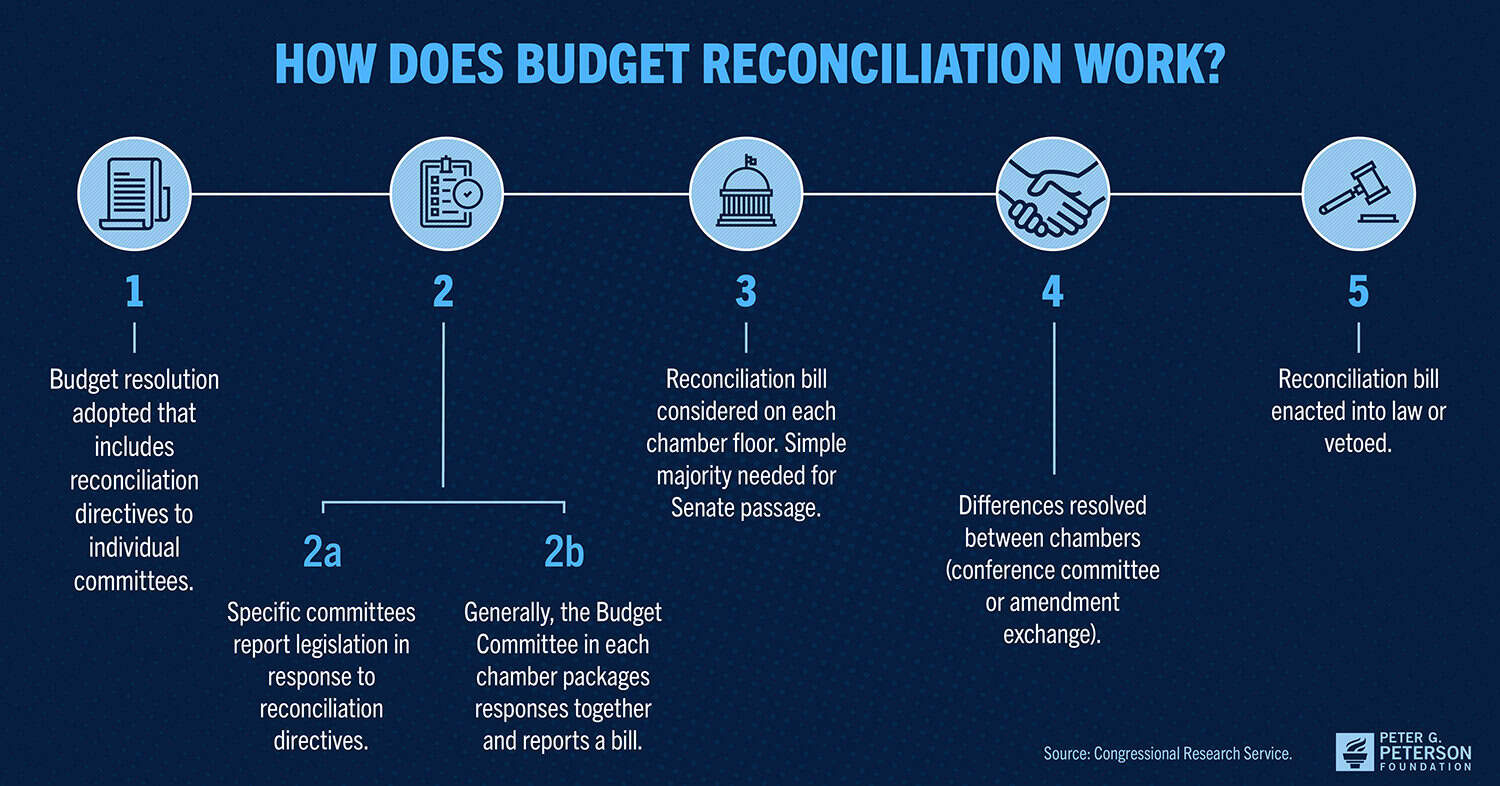
The process has two main phases: (1) adopting the budget resolution with instructions, and (2) developing and passing the reconciliation bill. It runs parallel to (but faster than) the regular legislative process.
  1. Adopt a Concurrent Budget Resolution with Reconciliation Instructions
    • House and Senate Budget Committees draft and the full chambers pass identical (or reconciled) concurrent budget resolutions.
    • The resolution includes reconciliation directives (instructions) to one or more committees, specifying dollar targets (e.g., "cut revenues by $X billion" or "increase direct spending by $Y billion") over a 5- or 10-year window.
    • No presidential signature needed. Budget resolution itself cannot be filibustered.
    • Example instruction: Tell the Senate Finance Committee to report legislation increasing revenues by at least $500 billion.
  2. Committees Draft and Report Reconciliation Legislation
    • Instructed committees (e.g., Ways & Means in House, Finance in Senate for taxes; multiple committees possible for omnibus bills) mark up and report changes only within their jurisdiction that meet the exact targets.
    • Amendments are allowed during committee markup.
    • If multiple committees are instructed, the House/Senate Budget Committee packages their recommendations into a single omnibus reconciliation bill (no substantive changes allowed at this packaging stage in the Senate).
  3. Floor Consideration
    • House: Goes to Rules Committee for a special rule (debate limits, amendments). Simple majority passage.
    • Senate: "Fast-track" rules apply — no filibuster, 20-hour debate limit, unlimited germane amendments (but "vote-a-rama" can occur). Byrd Rule challenges happen here (see below). Simple majority passage.
    • Points of order (including Byrd) can be raised; waiving them requires 60 votes.
  4. Resolve Differences Between Chambers
    • If versions differ: Either one chamber concurs in the other's bill, or a conference committee negotiates, or they use ping-pong (amendments back-and-forth).
    • Senate again uses fast-track rules.
  5. Presidential Action
    • Enrolled bill goes to the President: sign, veto (override needs 2/3 in both chambers), or pocket veto. Same as regular bills.

Visual Overview of the Full Process (from start with budget resolution to presidential desk):
reconciliation%20flow%20chart_v1.png.webp


how-does-budget-reconciliation-work-procedural-timeline.jpg


Senate-Specific Flow (privileged debate, Byrd reviews):
EPIC-Reconciliation-Process-in-the-Senate-Flowchart.png

The Reconciliation Process in the Senate

House-Specific Flow:
EPIC-Reconciliation-in-the-House-Flowchart-scaled.webp

The Reconciliation Process in the House

The Byrd Rule: Critical Limitations on What Can Be Included​

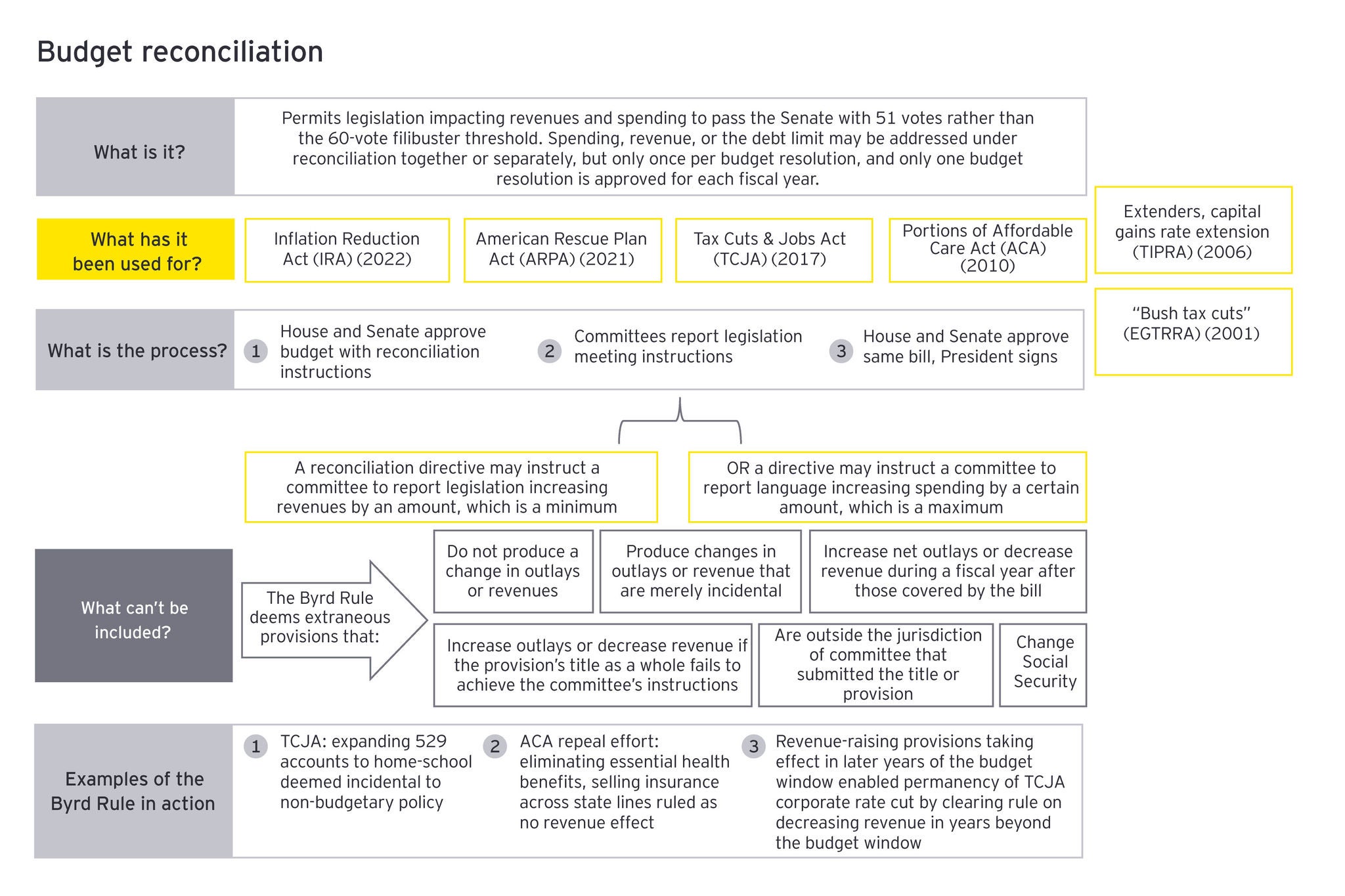
Named after Sen. Robert Byrd (D-WV), Section 313 of the Budget Act prohibits "extraneous" provisions. A senator can raise a point of order; if sustained by the presiding officer (or parliamentarian's advice), the provision is struck unless 60 senators vote to waive it.

Six Tests for Extraneous Provisions (any one triggers removal):
  1. No change in outlays or revenues (or terms/conditions).
  2. Changes in outlays/revenues but committee fails its instructions.
  3. Outside the jurisdiction of the reporting committee.
  4. Budgetary effects are merely incidental to the non-budgetary policy changes (the most common and subjective test).
  5. Increases the deficit beyond the budget window (usually 10 years) without offsetting.
  6. Changes Social Security (strictly protected).

Byrd Rule in Action Examples (from past bills):
  • 2017 TCJA: Corporate tax rate cut made permanent via revenue scoring tricks.
  • ACA repeal attempts (2017): Some provisions struck as incidental.
  • Recent bills: Provisions like SALT deduction expansions or certain energy credits carefully drafted to survive challenges.

Byrd Rule Basics Diagram:
ey-budget-reconciliation-v1.jpg

Budget reconciliation basics

Key Differences from the Regular Legislative Process​

AspectRegular Bill ProcessReconciliation Process
Senate DebateUnlimited (filibuster possible)Capped at 20 hours total
Senate Passage60 votes to invoke clotureSimple majority (51/50+VP)
ScopeAny policy areaOnly revenues, direct spending, debt limit
AmendmentsUnlimited (subject to rules)Germane only; vote-a-rama possible
FrequencyUnlimitedOnce per budget resolution type per year
Byrd RuleN/AStrictly enforced

Real-World Examples (Tied to Earlier ACA Mention)​

  • Affordable Care Act (2010): Senate passed original version via regular process. After losing 60-vote majority, Democrats used reconciliation for the "fix" bill (Health Care and Education Reconciliation Act) to make targeted changes without needing 60 votes.
  • Tax Cuts and Jobs Act (2017): Republicans used reconciliation for sweeping tax reform (simple majority in Senate).
  • Inflation Reduction Act (2022): Democrats passed climate, health care, and tax provisions via reconciliation after Build Back Better stalled.
  • Recent uses (as of 2026): Included packages like the American Rescue Plan (2021) and others referenced in current analyses.

Reconciliation is a strategic tool — highly effective for unified government but politically contentious because of its limits and the Byrd Rule's gatekeeping role. It does not replace the full committee/floor process; it accelerates the fiscal portions. For live examples or specific bills, track via Congress.gov (search "reconciliation" in bill text or reports). This process explains why major fiscal packages often succeed when regular legislation would fail in a divided Senate.
 

Byrd Rule Examples: Real-World Applications and How the Six Tests Work in Practice​

The Byrd Rule (Section 313 of the Congressional Budget Act) is enforced only in the Senate during reconciliation. Any senator can raise a point of order against a provision (or amendment) believed to be "extraneous." The Senate Parliamentarian advises the presiding officer, who rules. If sustained, the provision is automatically struck (no debate). Waiving the rule or overriding the ruling requires 60 votes. Since 1985, 83 points of order have been raised under the rule across 23 reconciliation measures; 73 were sustained (in whole or part), showing it is a powerful gatekeeper.

The rule has six tests for extraneous matter (any one triggers removal). Below are concrete, documented examples tied to each test, drawn from CRS analyses and actual reconciliation bills.

1. No Change in Outlays or Revenues (or Not a Change in Terms/Conditions)​

Classic example: Short titles and sense-of-Congress language. These are routinely struck because they have zero budgetary effect. In multiple bills (including versions of the Inflation Reduction Act and earlier packages), parliamentarians have removed "short title" provisions (e.g., "This Act may be cited as the 'Tax Cuts and Jobs Act'") when challenged.

Another: Pure policy reports or studies. Sense-of-Congress provisions or requirements for reports to Congress are extraneous unless they directly alter spending/revenue terms.

2. Committee Fails Its Reconciliation Instructions (Net Effect Violates Targets)​

1996 Personal Responsibility and Work Opportunity Reconciliation Act (welfare reform). The Senate Finance Committee was instructed to reduce outlays by specific amounts through FY2002. A Medicaid spending provision in its title failed to meet the FY2002 target (per CBO score). Senator Lott raised a Byrd point of order; it was sustained, and the Medicaid language was struck.

3. Outside the Jurisdiction of the Reporting Committee​

2015 Restoring Americans’ Healthcare Freedom Reconciliation Act. Senator Manchin offered an amendment on gun control and civil liberties. The budget resolution instructed only Finance and HELP Committees; Judiciary has jurisdiction over guns. Point of order sustained; amendment fell.

4. Budgetary Changes Are “Merely Incidental” to Non-Budgetary Policy Changes (Most Common & Subjective Test)​

This is the “heart” of the rule — the policy change must not dwarf the budget effect.
  • $15 minimum wage in American Rescue Plan Act (2021). Senator Sanders offered an amendment raising the federal minimum wage to $15/hour. CBO scored it as increasing deficits by ~$64–77 billion over 10 years (affecting 17M+ workers directly). Parliamentarian ruled the primary purpose was a massive labor-market policy change (impacting private-sector wages for tens of millions, plus employment effects). Budgetary impact was “merely incidental.” Point of order sustained; provision removed. (The ARP passed without it.)
  • Individual mandate repeal attempts (ACA 2015 & 2017). In 2015, full repeal of the ACA individual mandate was ruled extraneous. Parliamentarian noted it affected ~270–320 million Americans (coverage mandate) while budgetary savings were only ~$147 billion — policy effect vastly outweighed the dollars. In 2017 (during Better Care Reconciliation Act), similar provisions (plus defunding Planned Parenthood for one year and essential health benefits sunset) were challenged. Planned Parenthood defunding was allowed in a 2015 bill (targeted one provider) but struck in 2017 when data showed narrower impact.
  • Immigration status adjustment in Build Back Better (2021). Provision would have granted lawful permanent resident status to ~8 million people. CBO scored ~$124 billion cost over 10 years (nearly $700 billion over 20). Parliamentarian ruled the policy change (massive shift in immigration status) substantially outweighed the budgetary impact. Struck.
  • 529 savings plan expansion in Tax Cuts and Jobs Act (2017). Allowing 529 accounts for K-12/home-school expenses was deemed non-budgetary policy (education policy change) incidental to any tax savings. Struck under this test.

Workaround example (same bill): Republicans zeroed out the ACA individual-mandate penalty (not the mandate itself). This was treated as a standard tax-rate adjustment (direct revenue effect), so it survived and was included in the final TCJA.

5. Increases Deficit Beyond the Budget Window (Without Offset)​

Tax Cuts and Jobs Act (2017) drafting.
The budget resolution covered a 10-year window (FY2018–2027). To avoid violating this test, all individual tax cuts (rate reductions, standard deduction, etc.) were given a 2025 sunset — so the bill would not increase deficits in 2026+ without offsets. (Corporate rate cut was made permanent via other scoring offsets.) An amendment that would have extended cuts further (creating post-window deficits) was struck when challenged.

6. Changes Social Security​

Rarely litigated because drafters avoid it, but the rule strictly protects OASDI (Titles II, etc.). Medicare/Medicaid can be changed.

How provisions survive (or are killed):
  • “Terms and conditions” exception → Policy changes are allowed if they are the direct mechanism for altering spending/revenue (e.g., eligibility rules tied to grants). 1990 budget bill changed Coastal Zone Management Act funding conditions to hit spending targets — permitted.
  • Fungibility/offsetting → Committees can mix spending cuts and revenue increases to hit net instructions.
  • Strategic drafting → Sponsors consult the parliamentarian pre-floor to tweak language (e.g., making penalties $0 instead of repealing a mandate).

Summary Table of Notable Byrd Rule Outcomes
Bill/YearProvisionTest ViolatedOutcome
ARP 2021$15 min. wageMerely incidentalStruck
BBB 2021Immigration LPR pathwaysMerely incidentalStruck
TCJA 2017529 home-school expansionMerely incidentalStruck
TCJA 2017Individual tax cut sunsetsDeficit beyond windowDrafted with sunsets to comply
ACA Repeal 2015/2017Full individual mandate repealMerely incidentalStruck (penalty-to-zero workaround used in TCJA)
Welfare Reform 1996Medicaid spending add-onFailed instructionsStruck
2015 ACA RepealGun control amendmentWrong jurisdictionStruck

The parliamentarian’s rulings are advisory but almost always followed; they rely heavily on CBO/JCT scores plus qualitative judgment about “primary purpose.” This is why reconciliation bills are meticulously drafted and often require last-minute “Byrd baths” (striking or fixing provisions). It keeps reconciliation focused on fiscal policy rather than turning it into an omnibus vehicle for unrelated changes.

These examples show why major bills like the ACA (2010 fix), TCJA (2017), ARP (2021), and IRA (2022) succeeded or failed on specific provisions — they were carefully sculpted around (or struck by) the Byrd Rule. For the absolute latest rulings, Congress.gov or CRS reports (RL30862 or R48640) track every point of order.
 
Top