


Teacher
Professional
- Messages
- 2,669
- Reaction score
- 819
- Points
- 113
Researchers have developed an algorithm for modeling invisible zones.
John Murray-Bruce, a professor of computer science and engineering at the University of South Florida, presented a unique technology that can recreate hidden scenes in 3D format from just one photo. A new development can show what is behind walls, doors, or cars.
The algorithm, created by Murray-Bruce and his graduate student Robinson Tchaikovsky, uses faint shadows cast by objects on nearby surfaces to generate highly accurate and color-coded 3D models of hidden areas.
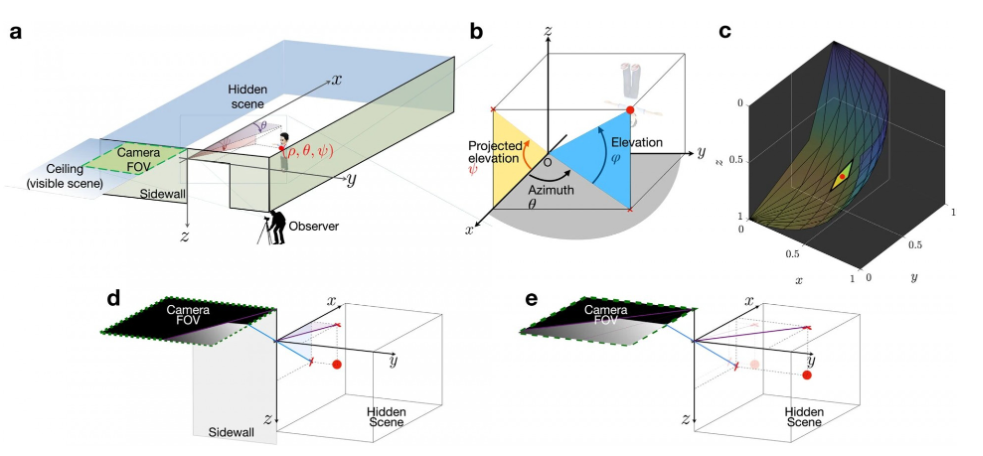
Their study, published in the journal Nature Communications, was the first to achieve this result using a conventional digital camera. Previous attempts to visualize hidden scenes required expensive and specialized equipment or produced only low-quality 2D reconstructions.
"Our work achieves a similar result using much less," Tchaikovsky said. "Now you don't have to spend a million dollars on hardware."
The main idea of the algorithm is to analyze the shadows that are created when light hits objects. By studying these shadows and applying complex mathematical algorithms, the system is able to recreate the hidden scene in a matter of minutes. "We transform ordinary surfaces into mirrors to reveal areas, objects, and rooms that are out of our sight," Murray — Bruce notes.
The development's application possibilities are extensive. For example, it can significantly improve the safety of autonomous vehicles by allowing them to anticipate obstacles around corners. In addition, the technology can be used in search and rescue missions to locate victims trapped in buildings or other structures. Law enforcement agencies can use the new technology to gather critical information at a crime scene without damaging evidence. This is especially valuable when access to the scene of an accident is restricted due to its danger or impassability. In the world of entertainment, development opens up prospects for creating exciting game adventures that immerse you in three-dimensional virtual worlds.
Despite its potential, the technology is not yet ready for commercial use. Tchaikovsky and Murray-Bruce estimate that it may take 10 to 20 years for car manufacturers and law enforcement agencies to start using it. In the near future, the researchers plan to continue working on the algorithm-to improve its speed and accuracy, as well as explore possible applications in autonomous cars and other areas.
The algorithm is already available for testing by other researchers, which, according to the authors, can inspire others to make new discoveries and make significant progress in the future.
John Murray-Bruce, a professor of computer science and engineering at the University of South Florida, presented a unique technology that can recreate hidden scenes in 3D format from just one photo. A new development can show what is behind walls, doors, or cars.
The algorithm, created by Murray-Bruce and his graduate student Robinson Tchaikovsky, uses faint shadows cast by objects on nearby surfaces to generate highly accurate and color-coded 3D models of hidden areas.
Their study, published in the journal Nature Communications, was the first to achieve this result using a conventional digital camera. Previous attempts to visualize hidden scenes required expensive and specialized equipment or produced only low-quality 2D reconstructions.
"Our work achieves a similar result using much less," Tchaikovsky said. "Now you don't have to spend a million dollars on hardware."
The main idea of the algorithm is to analyze the shadows that are created when light hits objects. By studying these shadows and applying complex mathematical algorithms, the system is able to recreate the hidden scene in a matter of minutes. "We transform ordinary surfaces into mirrors to reveal areas, objects, and rooms that are out of our sight," Murray — Bruce notes.
The development's application possibilities are extensive. For example, it can significantly improve the safety of autonomous vehicles by allowing them to anticipate obstacles around corners. In addition, the technology can be used in search and rescue missions to locate victims trapped in buildings or other structures. Law enforcement agencies can use the new technology to gather critical information at a crime scene without damaging evidence. This is especially valuable when access to the scene of an accident is restricted due to its danger or impassability. In the world of entertainment, development opens up prospects for creating exciting game adventures that immerse you in three-dimensional virtual worlds.
Despite its potential, the technology is not yet ready for commercial use. Tchaikovsky and Murray-Bruce estimate that it may take 10 to 20 years for car manufacturers and law enforcement agencies to start using it. In the near future, the researchers plan to continue working on the algorithm-to improve its speed and accuracy, as well as explore possible applications in autonomous cars and other areas.
The algorithm is already available for testing by other researchers, which, according to the authors, can inspire others to make new discoveries and make significant progress in the future.
